Showing posts with label Lock-off Strength Training. Show all posts

Tuesday, May 28, 2013

Lock-off training in Sport Climbing (V). Goal-based Exercise Proposals.


Versión en español

After this long and verbose chain of entries, now it's time to wrap up the series by putting forward some exercises that attend to each particular objective. But first we will go over some previously presented statements that will serve as a kind of preface:

Conclusions about Lock-offs in Climbing

- A specific strength exercise is one that reproduces the mechanical pattern (joint angles, speed of movement), duration of force application and kind of exercise regimen (concentric, isometric, eccentric), along the same muscle groups (or parts of them), that is typical of the gesture that we want to increase performance on. An additional characteristic is that they can also be facilitated or the opposite, like when we use elastic bands or added weight (Wilson et col., 1996; González-Badillo and Ribas, 2002; González-Badillo and Izquierdo, 2008).

- Regarding the usual duration of a lock-off, and focusing on technically proficient climbers, most of the time it is so short that it's even hard to appreciate it. The static phase of every move is the one where the elbow is no longer flexing and we start to let go of the hold with the other hand; a very brief moment that, as we already saw, lasts for 0,15 to 0,30seconds. From these figures we can deduce an important practical aspect:

This phase is so short that there are circumstances, specially for boulderers, or when grabbing small holds on steep overhangs, or that when a move requires a lot of precision, where there actually is not enough time for us to apply all the force that we are capable of. In these cases -and here we are just talking physical factors- what comes into play is what we can call explosive lock-off strength.
- In other situations a lock-off can last longer (from 0,5 to 1 second) and condition the performance in certain circumstances such as roofs, crossing hands, transitioning from roof to vertical, clipping, or long moves on a slab. They are also more frequent when onsighting or bouldering than when working a lead route.

- The more typical, and as such, specific joint angles are 90-100º and 45-60º.

- Performing either a high intensity or a prolonged lock-off (like the lock-offs to fatigue method) is very stressing for the elbow anddangerous. The reason is that in a tiny area a lot of structures come together: bicipital aponeurosis, ulnar collateral ligament, ulnar nerve, pronator teres, finger and wrist flexor muscles... so that this region is prone to suffer from compression (neuropathies). In addition, each of them is disproportionately small for the load that it has to bear, making it prone to microtraumas and overload (epicondylalgia and tendinopathies) when the intensity is excessive or the workout volume is suddenly increased. As someone who knows a thing or two about the elbow says, they are not at all prepared for the effort we subject them to while climbing

- So, if we ever feel we have to train lock-offs, it should be only after a long enough adaptation phase, so that the structures are better prepared to sustain the punishment of climbing; this includes hypertrophy, and changes in composition, visco-elastic properties and stiffness, metabolic changes, etc. The scale here is in years of constant and progressive activity (perhaps as long as 5), not in months.

Who can train lock-offs and when?


It goes without saying that beginners must NOT work this quality, not even those with an intermediate level. As that point it is better to focus on the development of a rich perceptive-motor repertory as the main physical work. In my opinion, there are JUST SOME cases, regarding particular goals, that justify training them, and this assuming an already advanced level. Even then, not the whole season long, and carefully picking the methodology:

- If you have ample (5+ years) of climbing experience, and an already high technical-tactical development that allows you to solve most sequences in a more efficient, not-so-static fashion

- If you have extensive (3+ years) upper body strength training experience, and are familiar with the pull-up gesture, strong enough and well-balanced shoulders, and high pulling force (15-20 pull-ups, and 5 or more with 10-15 kg added weight);

- If you aren't fully recovered from a previous weakness or injury in your elbows (at least 2-6 months of progressive rehab). NOTE: if the day after training lock-offs you notice elbow or shoulder pain, stop that training and take immediate measures no matter what;

- So, if after all the information you still deem beneficial to train this muscle action in some of its variants because it is a limiting factor for you; and you find a method that will not harm your technique or your tactics (see this previous entry); then, depending on your objective, you could perform 1-2 sessions a week for 4-8 weeks, resting 24-72 h between sessions and making sure you feel well-rested, always at the beginning of the workout and after a good warm-up, of some of the following proposed exercises:

Objective: Maximum Strength Lock-off


This would be the case where you feel limited in many of your climbs by your capacity -once the most efficient method is found- to hold a high percentage of your body mass, or to hold a position with just one arm for longer than usual.

1- Maximum lock-off: Suitable for climbers who can lock-off with one arm for more than 2 seconds and less than 5. Those who can hold longer could skip to the explosive methods described later. The methodology is as follows:
  • 2-5 sets of 1-2 seconds with complete recuperation (3+ minutes); 4-week cycles at most (ex.: 1st week 2 sets, 2nd week 3 sets...). Then we either stop it or rest for some weeks and start again changing some parameter (like number of sets or duration of effort) or, better yet, doing a different exercise for 4-8 weeks with a reduced load.
  • The load will be such that we avoid muscle failure, using added weight or facilitating (rubber bands) as needed. Don't worry, your gains won't be smaller this way, an you will reduce your risk of injury. We can use the concept of Effort Level (EL), that is the margin in seconds that we leave before muscle failure for a given load. For lock-offs we could use an EL of 1-4. We will choose the load like this: if we have to do 1-second sets with an EL(3), we will use a stronger aid or by the contrary add some weights so that we could hold the lock-off for 1-3=4 seconds, but we will only do 1 second, leaving that 3-second margin.
  • Depending on our level we can do it one-handed or with both arms.
  • Better to use a bar or a really good hold, preferably with our palm(s) facing us.

 
2-A facilitated exercise, good for familiarization, could be to grab the bar with our arm(s) already flexed, and always keeping both feet on the floor and maintaining the same elbow angle try one of these two: a) pull with the arms for one second max, or b) flex our legs a little so that some of our weight is transferred to the arms for around one second.

Objective: Explosive Lock-off strength

We learned that in a maximum isometric action, the highest force to time ratio or maximum explosive force is reached at 0,10-0,15 seconds, that incidentally is the usual length of locking-off while climbing. This doesn't mean that we are constantly working our explosive force while climbing, because most of the time the intensity is too low. But for those times when we need to apply a lot of force in a hurry (overhang, small holds), the goal would be to get the highest possible peak force at those 0,10-0,15 seconds. In other words, that we can unleash our capacity to generate a lot of force inside the available time window.

Here there are the exercises I propose, from easiest to more difficult, always keeping the load at a 30-50% of the maximum (the one that we could reach without the time constraint). We could do 1-2 cycles of 4 weeks each: 2-5 sets of 2-3 repetitions each, resting 3-5 minutes between sets (ex.: 1st week: 2 sets x 2 rep, 2nd week: 3 x 2 rep, 3rd week: 4x2rep, 4th week: 4x2rep...):

1-Explosive lock attempt. This consists of trying to perform an explosive contraction against an immovable resistance. This method was first proposed by Olsen and Hopkins (2003), based on the idea from Behm and Sale (1993) that the main stimulus for explosive strength development is the attempt itself and the force generated per time unit in that attempt, more than the actual muscle action or movement that results from it.

Attempt of Explosive Lock-off against a fixed resistance: starting with the desired angle, try to lock-off as fast and hard as possible. Note: the strongest among you will feel your feet leave the floor.

2-Jump-to-lockoff with both arms. Jumping to a good jug or preferably a bar, so that the angle of the elbow is the desired and we can apply force as soon as we make contact; hold the position just for the time needed to stabilize (ideally, less than 0,5 seconds), and drop back to the floor with our elbow still flexed to avoid additional stress. We can start doing this after having used easier methods (like facilitated lock-offs) without suffering pain. We can progress from using our body weight to adding some extra weight if we have already a high level and need further improvement (but never going beyond 30% of the maximum).

Jump-to-lockoff with both arms. Phase a: preparation to jump

Jump-to-lockoff with both arms. Phase b: jump and lock. Note; if you use added weight it's better to wear a weighted belt or vest than hanging some discs from the harness

3- Jump-to-lockoff with one arm.


Objective: Neural improvement for fast and efficient switch from dynamic to static contraction or vice versa.

Objective: Neural improvement for fast and efficient switch from dynamic to static contraction or vice versa.
With this we try to make our muscles used to fast regimen change (like static to dynamic), because it is a common situation in our sport. It is compulsory to have enough level on both types of contraction before working this capacity (ex.: 15 pull-ups with our body weight, more than 30 seconds hanging with flexed arms or more than one second with one arm, perhaps we won't ever be able to do it). We could use these exercises from least to most difficult:

1- Static-dynamic pull-ups (Cometti, 2000). There are several versions, and we need to keep in mind that the deceleration before the locking-off phase can cause sore biceps and triceps 1-2 days after the session. So, be careful:
      -Variant 1: Pull-up + 90º lock-off. This is the one that I consider the most specific. Given that we have enough strength, we pull as fast as possible until reaching 90º and holding the position for 0,5 to 1 second. I prefer this way to the popular one where there are 3 stops at 3 different angles both in the concentric and the eccentric phase like in Ruben's video 3:25 to 3:52
            *Variant 1b: Even more specific and probably more funny, but requiring high explosive and technical level. It consists of doing a long dyno where we have to swiftly flex our arm upon contact to fight the resulting cut-loose.
Nacho Sánchez, Tolmojón, 8B+- Tamajón (Guadalajara, España). Photo: Raul Santano
             *Variant 2a: Lock-off + pull-up (really advanced) Start by locking-off at 80% of the maximum and then doing an explosive pull-up at 30% of the maximum. The challenge here is the fast switch in load. I suggest you use rubber bands, rest your feet on something or even this solution:

Phase a: one-armed lock-off
Phase b: hold with both arms and pull-up


           *Variant 2b: Jump + lock + pull-up. This is one step above the previous one, more explosive and for elite level. It begins by jumping to a hold, doing a short lock-off and finally an explosive pull-up. There is a video of Nacho Sánchez performing it while training for Insomnio, his second 8C boulder (2:12 to 2:15)

     -Variant 3: pull-up + lock-off + pull-up. Here the load is constant, around 57-80% of the maximum both for the static and the dynamic phases. This exercise could be indicated for working the strength-endurance to the change in regimen. The number of repetitions will be higher, and the goal is to reach failure in the last set of the session.

2- Ladder hand-walking. High transfer to roof climbing. Depending on our level and goals, we will do the usual 2-5 sets of 2-4 reps with a complete rest.
Jurgen Reiss training. Source: http://www.juergenreis.at

3-Pull-up and release one arm. It is a fast pull-up that ends raising one arm as if we wanted to reach a hold. If we can have something to actually reach and touch it will be faster and more real.
Variant a: Reaching up when the elbow is at 90º
Variant b: Reaching up with the elbow at 45º
4- Campus board: The static phase in this exercise is the moment that we spend "tightening" the elbow prior to reaching with the other hand, that my video analyses show is identical to the 0,15-0,20 seconds typical of climbing. This makes it very specific, but if we lack some system to facilitate the exercise (like pulleys) the intensity tends to be too high and we run into the eternal problem: the control of the load. Partly because we are not always aware of its importance.

Nacho Sánchez seems to display the qualities needed for the campus board
About the campus...
This is why, no matter if we focus on the fingers (with small edges), the pulling force (with long reaches) or the explosive component (like what we described today); and given that there is always some mix of the three...

... This is an exercise that must be reserved for advanced phases, and only by those who are familiar with other, easier methods, that have provided them with the strength necessary to pull and, more importantly, to absorb the deceleration/acceleration of the body when reaching the next edge.

How are you struggling up a campus board if you can't do 15 pull-ups in a row?
Each time your hand lands on the next hold your body sinks, your elbows fly; do you wriggle your whole body when reaching because you can't simply ascend by flexing your arms?
Keep in mind that what our muscles can't cope with, is in part transferred to the supporting structures like tendons, ligaments, joint capsules, cartilages...

This is true for all kind of exercises. But the campus board is so explosive that shoulders, elbows and fingers have no time to give us warning before getting overloaded by a brusque movement. Why is it so common to hear people say their elbows hurt when doing campus? And.. has anyone taken a moment to think what capacity does this exercise develop? What can it be used for?
Well... as you see it can be used for several things (but not all of them at once, please!). Be careful, picture your elbows taking turns to bear the weight of your whole body.

So, some planning is in order, ask yourselves what quality you need to improve at each moment, use the easiest method available to you, keep away from injury and develop steadily. Only that way you will get long-term results.

Good luck!

RELATED LINKS
REFERENCES
  • Behm DG, Sale DG (1993) Intended rather than actual movement velocity determines velocity-specific training response. Journal of Applied Physiology 74(1):359–68.
  • Cometti, G. (2000): Los métodos modernos de musculación. Paidotribo
  • Gonzalez Badillo and Ribas, J (1996): Fundamentos del entrenamiento de la fuerza. Inde
  • González-Badillo, JJ, and Izquierdo, M. (2008): Evaluación de la fuerza en el control del entrenamiento y el rendimiento deportivo. In Izquierdo, M. (editor); Biomecánica y Bases Neuromusculares de la Actividad Física y el Deporte. Panamericana
  • Maloney, S. (2012). Explosive Isometrics: Speed Training with the Brakes On. www.elitefits.com. [online] Entry from july 25, 2012. Available at: http://articles.elitefts.com/training-articles/explosive-isometrics-speed-training-with-the-brakes-on
  • Olsen PD, Hopkins WG (2003) The effect of attempted ballistic training on the force and speed of movements. Journal of Strength and Conditioning Research 17(2):291–98.
  • Siff MC (1993) Understanding the mechanics of muscle contraction. National Strength and Conditioning Association Journal 15(5):30–3.    
  • Wilson, G. J., Murphy, A. J., & Walshe, A. (1996). The specificity of strength training: the effect of posture. European journal of applied physiology and occupational physiology, 73(3), 346-352.

Sunday, January 27, 2013

Lock-off Training in Sport Climbing (IV). A Review of several Methods and an Introduction to Explosive Lock-Offs


Versión en español

As I promised Randy some time ago when responding to his comment -which was the starting point for this series-, we are going to look at some well known methods: statical-dynamical pull-ups and functional isometrics. And, shocker, this already long series will have one more entry (the 4th) that will suggest some specific exercises based on all the information gathered at this point. Afterwards, it will be you who will decide whether they are suitable for your needs, and how to incorporate them into your training.
Ramón Julián at 2009 Arco Rock Master (Italy). Photo: Giulio Malfer. Fuente: rockmaster.com
Functional isometrics
This method was proposed in 1962 by Hoffman, and valued by authors like Giorgi et al. (1998), Fleck and Kraemer (2004), or Keogh et al. (1999). At the present there are a number of variations, using it by itself, or as part of a sequence of exercises in other method that we will discuss later and that has several different names: complex, combination training, contrast loading system, or contrast training

In their more basic form, they consist of a dynamic movement like a pull-up, followed by a maximum isometric contraction at the angle of maximum effort (Fleck and Kraemer, 2004).

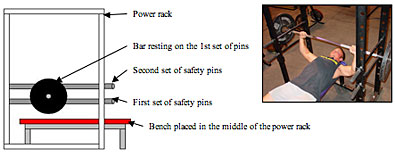
A functional isometric set-up for bench press: Start the bar at a specific height, and lift it two to three inches against a second set of safety pins. Then hold the position for six to nine seconds. Keep on adding weight until you can't lift it. Just hold the bar firmly against the second set of safety pins for at least six seconds, while maintaining a good lifting posture. Source: www.t-nation.com

The goal is to put the maximum resistance at the point where the joint has the least mechanical advantage or sticking point (Zatsiorsky and Kraemer, 2006), the underlying logic being that if we gain strength at the most difficult angle, we will experience an improvement along the whole range of movement. For example, there are two such points for the elbow flexors, at 170º and 50º, very similar to those for the triceps.

THE EFFECTS OF FUNCTIONAL ISOMETRICS ON TRAINED ATHLETES
Keogh et col. (1999) evaluated the effects of functional isometrics on trained subjects using the bench press (6RM that included a 2'' maximum isometric contraction at 160º), and compared it with other classic methods for 6RM, eccentric training and power exercises. The functional isometrics group of participants registered the highest values for the concentric phase when doing 1RM. This is in line with the work of Jackson el al. (1985), Giorgi et al. (1989) and O'Shea and O'Shea (1989), who suggested that this method could be useful for experienced and very strong subjects to improve on 1RM (RM = repetition maximum).
Jesús Beltrán "Brother". Photo: Javipec
On the other hand, in the study by Keogh et al. (1999), the effects of this method over power and endurance were significantly lower than those experienced by the groups that used eccentric, explosive and heavy load (dynamic) methods.

WHAT ABOUT THE LESS TRAINED ATHLETES?
For non-trained subjects the results are more varied. Gentil et col. (2006) found that 10 reps of 5-second maximal isometric leg extensions with a load that provoked muscle failure, induced a greater blood lactate accumulation and time under tension than the more traditional dynamic repetitions. This facts, according to some authors, is associated to an increase in muscle volume and maximum strength.

CONCLUSIONS AND RECOMMENDED EXERCISES
In my opinion, the key issue here is that, according to the mentioned studies, we should manage to apply, during each repetition, a maximum or near maximum load both in the concentric and the isometric phase. We usually can bear 10-15% more weight with an isometric contraction than with a concentric one; so, when we momentarily lock-off, we should add (don't ask me how right now) that 10-15% load. Later we will propose an exercise that can fullfill those requirements.

Complex training
The above mentioned combination (a.k.a. conjugated, combination, bulgarian, or contrast (Cometti, 2000) training, is based on the postactivation potentiation (PAP) effect that results from mixing light and heavy loads and different types of contraction during the same set or session (isometric and dynamic, for example). Given that the exercises must be executed at the maximum possible speed and that different intensities are used, there will be an increased dynamic power (Pmax) and rate of force development during the lighter load exercise. This would have in theory a positive effect on neural activation, power and therefore on maximum strength.


LOOKING AT THE EFFECTS
Research into complex training has been done from two perspectives: the acute, immediate benefits of performing a heavy strength exercise as a warm-up prior to a maximal power or speed performance (such as vertical jump test) and the long-term training adaptations that can be developed from a periodized complex training program.
Regarding acute effects in Some studies have evaluated how combination training affects performance of the upper limb in power exercises like throws; they suggest that it can be as, but no more, effective than other "traditional" methods for children, women and people with a low training level (Ebben, 2000).

Nonetheless, as was the case with the previous method, it can be more beneficial for men, and for those with a higher level of training (Ebben and Watts, 1998), possibly due to their higher percentage of fast twitch fibers (Hamada et al., 2000), and/or their superior maximum strength (Ebben, 2002).
French, Kraemer and Cook (2003) did a study with fourteen track and field athletes, and data indicate that performing a sequence of repeated maximal isometric knee extensions (3 repetitions of 3 seconds)  prior to (30 minutes) selected dynamic exercise (0.25 seconds) may have favorable effects on performance beyond standards achieved without prior heavy loading. Lastly, it is interesting to note that the PAP ergogenic stimulus has been found to last between two-to-thirty minutes (Chiu, Fry, Weiss, et al. 2003; Rixon, Lamont, Bemden, 2007)
Luis Muñoz. Photo: Javipec

THE STATIC-DYNAMIC METHOD
There's a class of combination trainings popular among climbers, the so called iso-dynamic by Verjoshansky (1986), or static-dynamic by Cometti (2000). Depending on the desired effects, they can also be called iso-miometric and iso-ballistic. Now, the most used variant among european climbers is the one described by Cometti, that in our case consists of mixing pull-ups and lock-offs like this:
An explosive pull-up is done up to certain angle, then a lock-off is maintained for certain amount of time, and finally the pulling movement is finished at high speed. The author suggests the use of 2-second lock-offs, and loads of about 60% of maximum concentric strength for the pull-ups. In this video there's an example (min 3:25 to 3:50).

STUDY OF THE EFFECTS
I couldn't find any studies that tested the effects of this exercise on pull-up maximum strength and power endurance, on power when doing more specific exercises like campus board, or general climbing performance.
In theory, given the similarity to the pulling-locking gesture so common in climbing, it coul be of some interest. But it remains to be seen what for and how to use it.

WHERE CAN THIS METHOD BE OF HELP?
Several facts must be taken into account before answering:
Obviously, the deceleration that occurs when we stop pulling and lock, clashes with the explosive pulling force that we were generating the moment before.
Lega on "Supertitte", Castillo de Bayuela (Toledo, Spain). Photo: Carles de Diego. Source: carlesdediego.blogspot.com
Secondly, if we have to resume the interrupted movement in an explosive fashion, we will be subject to an effect observed by Tihanyi et col. (1989) and Van Cutsem and Duchauteu (2005): the act of performing an isometric contraction reduces the amount of force that can be immediately be applied per unit of time (RFD = rate of force development) in a subsequent concentric contraction. The explosive force will be lower than if we hadn't previously done an isometric contraction.
Mery on "Valle de Rosas", 8a+, Cuenca (Spain). Photo: javipec
Thirdly, regarding the development of locking-off strength, and lacking any relevant literature in this matter, it stands to reason that if we want to improve our maximum or explosive locking strength it will be more effective to work it by itself instead of mixing it with pull-ups. The reason is that the control of the load gets more difficult, because both types of contraction require different absolute loads and exertion durations.

So, especially for developing maximum strength (using more than 1RM), power, and power-endurance, the dynamic methods seem more effective when it comes to pulling; conversely, the static methods will be more suitable for maximum and explosive locking strength and locking power-endurance.
Nevertheless, there is an area where this method can be of help, and that is to improve our ability for swiftly and effectively transitioning from a dynamic contraction (pulling) to a static one (locking-off) and vice versa. Ability that, as we already know, is constantly demanded in our sport.
Oscar Martinez on "La Soucoupe", 7C+, Chironico (Switzerland). Photo: Joseba Saiz. Fuente: Oscar facebook profile
Training Objectives for Improving the Locking-off Ability
Summing up, with the intention of setting priorities and choosing a training methodology for our planning, we could determine different training goals, or different effects to have in sight related to lock-off ability:
  • Maximum locking strength
  • Explosive locking strength
  • Fast and effective transition form pulling to locking-off and vice versa
  • Power-endurance specific to the pulling-locking gesture
We have already gone over the two last, and the first is easy to figure out but, what about maximum locking strength? Is it not an oxymoron to put 'explosive' and 'static' in the same sentence? What can this possibly mean?
This explosive isometric exercise consists of trying to push the bar against the stoppers, or pulling it, in an explosive way. Source: articleselitefts.com
Explosive and maximum isometrics: fast and slow lock-offs
As stated by Verkhoshansky and Siff (2000) it would be very reductionist and wrong to define isometric contraction symply as one where a static muscle action takes place for certain amount of time. If we look at a graph showing how the force applied against an unmovable resistance until fatigue varies with time, we will see what is called the force-time (f-t) curve. The important word here is 'curve' and has several phases:

1- Force-generation or development phase: The muscle builds up tension until the Peak Maximum Force (PMF) is reached. It's been shown that this maximum isometric force takes at least 0,8 to 1 second.

Another remarkable aspect of this phase is that there is a moment, when the f-t curve is steepest, that is, the ratio between the force produced and the time to reach it is at its best. Such is the value for the maximum explosive force, the peak of force that has been achieved in the shortest possible time. This is around 30% of the PMF (max RFD in the graph below). Stone, Stone and Sands (2003) call "starting strength" the one that is applied during the first 30ms, and that determines the speed of the movement when we talk about a dynamic contraction. Do any of these figures remind you of the previous chapter?
Sample f-t curve. "Starting strength" is the force produced at 30ms; "explosive strength" is max RFD, which is the moment of highest explosive strength, and takes place at about 30% of PMF. "maximum strenght" or peak force (PF) is the greatest force produced under a given set of conditions. (Stone, Stone and Sands, 2007)
2- Steady State phase: Holding the maximum force. Lasts for about 3-6 seconds.

3- Final or Force-decay phase: Reduction in force due to fatigue.

According to this, we find fast or explosive isometric contractions where the generation-force phase is short, and the force generated per unit of time (RFD or explosive force) is very high; the downside is that there is no time to reach our maximum strength (PMF). Reversely, in a slow or maximum isometric the explosive component is much lower, but we can reach our peak force. Using one or the other is not only a question of what method we use to solve a movement; many variables take part, like personal climbing style, wall angle, hold size, finger strength (if we can barely grab a hold, we don't have time to gather a lot of maximum pulling or locking strength), and even muscle composition and training habits.
RFD curve for fast or explosive isometrics versus slow or maximum isometrics
Nacho Sanchez on Memento, 8C, Silvretta (Switzerland). Photo: Rebeca Morillo. Source: Nacho's blog
And now, if you have a lot of general climbing experience (more than 3 years), and upper body strength training experience (more than 3 years), a high pulling force (15-20 unweighted pull-ups, more than five with 5kg added weight); if you don't have any injuries or other limiting factors in your elbows; if you are convinced that, after absorbing all this information, it can help you countering some of your weaknesses, then I'll show you some exercises.
But that, will be the topic of the next entry in the series.

LINKS RELATED
Lock-off Training in Sport Climbing (I). Does Static (lock-offs) Training have any Effect over Dynamic (pull-ups) Performance?
 Lock-off Training in Sport Climbing (II) Does our locking-off ability have any influence on our performance? Is it so important to train it?
Lock-off Training in Sport Climbing (III) Do you really lock-off?
 

REFERENCES
  • Cometti, G. (2000): Los métodos modernos de musculación. Paidotribo.
  • Chiu, L.Z., Fry, A.C., Weiss, L.W., Schilling, B.K., Brown, L.E., & Smith, S.L. (2003). Postactivation potentiation response in athletic and recreationally trained individuals. Journal of Strength and Conditioning Research. 17(4), 671-677.
  • Ebben, W. P., Watts, P. B., Jensen, R. L. and Blackard, D. O. (2000): EMG and kinetic analysis of complex training exercise variables. Journal of Strength and Conditioning Research 14(4), 451-456.
  • Ebben, W. P. (2002): Complex training: A brief review. Journal of Sports Science and Medicine 1, 42-46
  • Fleck SJ, Kraemer WJ (1997). Fleck SJ, Kraemer WJ (2004): Designing Resistance Training Programs, ed 2. Designing Resistance Training Programs. Human Kinetics Publishers 
  • French, DN, Kraemer, J, Cooke CB (2003) Changes in Dynamic Exercise Performance Following a Sequence of Preconditioning Isometric Muscle Actions. Journal in Strength and Conditioning Research, 17(4), 678-685
  • Gentil, P., Oliveira, E., and Bottaro, M (2006): Time under Tension and Blood Lactate Response during Four Different Resistance Training Methods. Journal of Physiological Anthropology; 25(5): 339–344
  • Giorgi A., Wilson GJ, Weatherby RP (1998) Functional isometric training: its effects on the development of muscular function and the endocrine system over an 8- week training period. Journal of Strength and Conditioning Research, 12, 18-25
  • González Badillo JJ and Gorostiaga Ayestarán E. (1995) Fundamentos del entrenamiento de la fuerza. Aplicación al alto rendimiento deportivo. Zaragoza: INDE; 1995.
  • Gonzalez Badillo and Ribas, J (1996): Fundamentos del entrenamiento de la fuerza. Inde
  • González-Badillo, JJ, and Izquierdo, M. (2008): Evaluación de la fuerza en el control del entrenamiento y el rendimiento deportivo. In Izquierdo, M. (editor); Biomecánica y Bases Neuromusculares de la Actividad Física y el Deporte. Panamericana
  • Hamada, T., Sale, D.G., MacDougall, J.D., and Tarnopolsky, M.A. (2000): Postactivation potentiation, fiber type, and twitch contraction time in human knee extensor muscles. J Appl Physiol, 88: 2131–2137 
  • Jackson, A.; Jackson, T., Hnatek, J., and West, J. (1985): Strength development: Using functional isometrics in an isotonic strength training program. Res. Q. Exerc. Sport, 56:234–237.
  • Keogh, J.W.L., Wilson, G.J., and Weatherby, R.P. (1999): A Cross-Sectional Comparison of Different Resistance Training Techniques in the Bench Press. Journal of Strength and Conditioning Research, 13(3), 247–258
  • O’Shea, K.L., and O’Shea, J.P. (1989):  Functional isometric weight training: Its effects on dynamic and static strength.J. Appl. Sport Sci. Res.3(2):30–33
  • Rixon, K.P., Lamont, H.S., and Bemden, M.G. (2007). Influence of type of muscle contraction, gender, and lifting experience on postactivation potentiation performance. Journal of Strength and Conditioning Research, 21(2), 500-505.
  • Tihanyi J, Bosco C, Fekete G, and Apor G (1989) The effect of muscle structure and training conditions on the rate of torque development. Review of the Hungarian University of Physical Education, Budapest, 185-198
  • Zatsiorsky VM, and Kraemer WJ (2004) Science and Practice of Strength Training-2nd edition. Human Kinetics
  • Van Cutsem, M., and Duchateau, J. (2005). Preceding muscle activity influences motor unit discharge and rate of torque development during ballistic contractions in humans. The Journal of Physiology, 562(2), 635-644.
  • Verkhoshansky, Y., and Siff, M. C. (2004). Superentrenamiento.Madrid. Paidotribo.

Monday, September 17, 2012

Lock-off training in Sport Climbing (III) Do you really lock-off?


We completed the literature revision in previous posts, and now it's time to apply this knowledge, as I had set out to do.
Watching videos, and with the help of kinovea, an open source tool, I have analyzed the gesture that is the subject of this entry through the following subset of real climbing:
- lead style
- high level climbers
- different angles of climbing
- difficulty 8b+ to 9a
- rock and competition
- both onsight and redpoint
From these I have inferred some trends that can be of interest, although I need to make clear that this is a piece of field work and not a proper scientific study. So, the conclusions here exposed are more of a personal take on the matter.

Analysis of the pulling/lock-off gesture in Climbing
If we study in slow motion our pulling movements (specifically, our upper body; added sentence on 09/10/2012; thank you,  Douglas Hunter) when we are not matching, resting, clipping, in compression moves (added sentence on 08/10/2012; thank you, Gianluca), or using tiny intermediate holds, we can divide the holds into three categories; H (the one we will Hold from), R (the one we are going to Release) and T (our Target hold). Then we can distinguish several phases.
We are going to look at each of those phases to collect some data.

AVERAGE LOCKING-OFF DURATION

Phase 1: Initial. Pulling and building Momentum with both arms
This is when we are pulling with both hands from H (the one we'll keep holding) and, R (the one we are going to release); usually more force is applied on H, especially towards the end, when we are about to release R and go for T; the legs, and really the rest of the body help to impulse in a coordinated way. 
Duration: most of the time, 0,30 to 0,50 seconds.

Phase 2: Pulling/locking with one arm while releasing the other
In this phase we have already released R, for the time needed to get to T. For a brief amount of time we are applying our force with one arm, the H one, 
Duration: most of the times, 0,4 to 0,5 seconds, but it can be as low as 0,2 seconds in certain movements, more often with very explosive climbers, or as high as nearly 1 second on very long reaches in not very steep routes, especially with more static climbers.
Shauna Coxsey - Bouldering World Cup,  2012. Photo Heiko Wilhem. Source UKclimbing.com
Chris Sharma. Demencia Senil, 9a+. Margalef (Tarragona). Photo: Pete O'Donovan
Luis Alfonso Félix. Eros Tensa el Arco, 8b+ .Cuenca. Photo: José Yáñez.

Now, if we look more closely to this phase, we will realize that the static part of it, during which we are locking-off, is most often practically imperceptible. That's why in my previous post I thought it very interesting to reconsider the whole concept of locking-off.
The best climbers devote very little to no time (0,15-0,30 seconds) to maintain the desired angle and actually lock-off. What they do is to take advantage of the previous impulse so that they can keep on flexing or extending their H arm before reaching the angle needed to grab the Target, in a way that leaves little to no room for an isometric phase. This is even more true when the holds are smaller and/or the route steeper.
    Helena Alemán. Spanish Climbing Championship (Gijón 2012).
    Photo: Darío Rodríguez. Source: top30 facebook
        Shauna Coxsey

      Phase 3: Stabilization and getting ready for the next move
      Our hands are already on the H and T holds, and we are locking-off to a certain extent (although most certainly with different angle and lower intensity) with our H arm, while we steady ourselves, do the required footwork, and adjust our fingers to the T hold so it can eventually transition into our new H hold. Next we will 'undo' the lock with our former H -and soon-to-be R- hold, and move our feet in preparation for the following move.
      Duration: most often 2 to 3 seconds, going up to 5 seconds or more in the most complicated movements. This phase comes out as the longest one.
      Giannis Agathokleous
      At this point it's important noting that if we reach a hold by dynoing, it will be fundamental to quickly and coordinately pull with both arms and the whole body (with emphasis in the lower back, waist and legs) to steady ourselves.
      Sean MacColl - Bouldering World Cup - Vail, USA 2012. Photo: Heiko Wilhelm

      MAXIMUM LOCKING-OFF DURATION
      I have recorded 2-5 second locks when:
      • trying to onsight a route, while figuring out how to grip a hold.
      • in some sections that demand precision and body tension, like aiming for a pocket or climbing on roofs...
      • when clipping the rope, more often in competition where clipping points are used to increase the route's difficulty.
      Nevertheless, these figures are a function of level. The more experienced climbers will try to clip more efficiently, keeping their arm straight and taking less rope. They will also need less time to sort out a section or a grip position while onsighting.
      Mina Markovic. Lead Climbing World Cup, Kranj 2011. Photo: Luka Fonda
      ELBOW ANGLE
      It varies with the steepness of the route and across different moves. The most used one, though, and the most specific is the 90º one. In second place come those close to 45º, typical of slight overhangs, transitions from roof to vertical and gastons.

      Javipec at Bayuela
      This said, all these numbers vary with several factors:
      - The more overhanging and/or tinier the holds both hand and foot ones, the shorter the locking time for a given hold separation.
      - Personal style: hesitant and static; onsight (in contrast with worked), routes (compared with boulders) will yield the longest locking-off times for the same difficulty.

      - Girls in general show longer times in all phases due to our lower maximum and explosive strength. If we add that training frequently ignores gender particularities, and the tendency to choose routes that keep us from challenging our weaknesses instead of working on them, there is a tendency to develop a more static style. The outcome is an increased fatigue for a given route (due to a longer time grabbing each hold), lack of ability to solve certain moves like dynos or very steep overhangs, and a general slow down of progression. Even overuse injuries in the elbows.

      LOCKING-OFF AVERAGE INTENSITY
      If we measure the intensity by the percentage of body weight that the arm has to bear, and look at the 2 phases where lock-off takes place, we observe the following:
      - Hand releasing phase: the intensity can be high or medium depending on the type of move and overhang angle, but as far a I have been able to observe, rarely does the H arm bear a high percentage of the body weight, and, as stated above, this isometric phase tends to be lower than half a second long.


      Jorg Verhoeven - Lead  Climbing World Cup - Denver, 2011
      - Stabilization: Here body mass is already supported by both arms, so that intensity is even lower than in the previous phase.
      Nacho Sánchez. Tolmojón, 8B+ (Tamajón, Guadalajara).
      Photo: Raúl Santano. Source: flickr

      INTERVAL BETWEEN LOCK-OFFS/PULLS
      It is around 10-15 seconds in average. Less frequently, it lasts 5-8 seconds, or more than 20, but it is conditioned by the holds distribution, the need to clip and, as ever, the climbers' style. We need to be aware that we need to clip approximately every 2 movements in competition, or every 4 to 6 in rock climbing.

      ¿Are any of these figures of relevance to medium and lower level climbers?
      The numbers above are applicable to climbers with a high technical and physical level, but can vary wildly among medium and low level climbers. In fact, they do.
      From my observations, the less experienced climbers display longer locking-off times, possibly due to:
      - limited perceptive and motor repertory that leads to indecision when it comes to sorting out a sequence,
      - reduced balance and poor management of the center of mass, that makes them try to put their body 'closer' to the holds, flexing their arms too often and locking-off constantly,
      - insecurity due to their lack of experience or their undeveloped control of fear,
      - insufficient memorization to climb fluidly through the key sections.
      Source: www.mikeoffthemapfiles.wordpress.com
      ¿Does this mean that in these levels, or with these weaknesses, we need to work our lock-off more, or that it is better just to improve our physical, technical and tactical aspects?
      My answer is clear. It would be sensible to focus on the latter strategy during the initial and intermediate stages (2-4 years), and then to progressively include specific physical contents (like lock-offs, finger maximum strength, etc) once we are in the right path of technical-tactical improvement.

      And now that we know a bit more about how long a lock-off usually lasts, in high level climbers, we can ask ourselves the question:


      All right, then... ¿is it useful to train 'long' lock-offs to improve an action that normally lasts less than half a second?

      My answer is Not. And, to elaborate on it, in the next entry I will talk about the importance of training for each of the phases using exercises whit specific duration, speed and intensity. I can tell you in advance that we'll learn about some explosive isometric methods and exercises, that will try to develop our ability for reaching very quickly our force peak, within those tenths of a second when we 'stop' pulling and 'lock' to make contact with our Target hold. We will also take a look at other exercises with a duration and style oriented to the previous phase, when we are pulling from the holds, something that is tightly associated with the locking-off gesture.

      In conclusion:
      Locking-off, at least in modern routes and competitions, and for climbers with a high technical-tactical level, is ideally a very brief action, and of medium an low intensity in general. In a way, it probably wouldn't deserve to be called lock-off...
      In addition, the the time that passes between the harder pulls and lock-offs should be enough to recover from them in most occasions.

      However, it is the intensity factor along with the duration, especially during phase 2, what will determine if in some instance -for a particular route or style that we are training for- this locking-off ability could become the limiting factor to send a route. This leads, you saw it coming, to another question: 


      What kind of movements or routes can benefit from training our locking ability? 

      By closely looking at these pictures or thinking a bit by yourself, you may find the answer:
      Mina Markovic. Lead World Cup (Kranj 2011). Photo: Luka Fonda 
      Dani Andrada. Ali-Hulk, 9a+ (Rodellar, Huesca). Photo: Pete O'Donovan
      Edu Marín. "Ciudad de Dios", 9a (Santa Linya, Lleida). Photo: Pete O'Donovan 


      Nacho Sánchez. Insomnio, 8C (Crevillente, Alicante). Photo: Rebeca Morillo
      You got it...
      For some moves in roofs, or going from a roof to vertical, crossing hands when traversing an overhang, holding a barn door, a key clipping...
      For these, or other cases that you consider this ability is important for... what would be the best method to train it?

      Perhaps with the information that we have to this point you can answer this question by yourself, but, if it's not the case, the next entry will be devoted to reflecting about it. We will discuss the usefulness of methods like functional isometrics, Cometti's static-dynamic pull-ups and other, less known, ones...

      NEXT ENTRY: Locking-off training methodology

      RELATED LINKS: 
      Lock-off strength training (I)
      Lock-off strength training (II)