Showing posts with label Review. Show all posts

Thursday, February 7, 2013

Training Pinch Grip Strength for Climbing. Are dead hangs the right way to do it?


Versión en español (Translation from the Spanish original published on December 28, 2012)

While I wrap up the lock-off series that we started months ago, we are going to have a look at an issue that a reader raised a while ago:
Hi Eva,

First of all: thanks for a great blog! Very interesting to read about your research and training tips.
I think it would be interesting to hear your thoughts on developing pinch strength. The training of this grip is not too often addressed but in practice I find it is a very important grip type. The strength of the thumb is not developed using the "standard" finger training exercises (dead hangs, campusing etc.). What would you recommend for increasing the strength of the pinch grip?

Best regards!

Ragge September 3, 2012 at 12:13 PM

Hi Ragge,

Thank you! I agree with you. That's why I have been meaning to talk about this topic for some time now ;-)
Firstly, you are so right. There is not a lot of information on this topic and, as you suggest, the hangboard may not be the best method for training this quality... or perhaps it's not so far fetched. Let's see:

How could we train correctly our pinch strength hanging off a vertically oriented pinch?

Well, hanging directly below a board with straight arms like we do for edges and pockets is not the ideal situation. We should hang in a way that left our wrist in a natural position (15º-30º extension, Irmhan, 2001), the forearm in a neutral position (neither supine nor prone) with our thumb pointing 'upwards' (McGorry and Lin, 2007) and our arms in front of us. If we add to this combination an ideal shoulder flexion of 45º-135º, we will be in the best position to apply the maximum force using this grip type (Kong et col., 2011)
 
The best body posture would be like this:

Or, at least, like this one where the hold is downward facing; our body would be upright, but our elbows would be flexed so that the thumbs could oppose the force made with the other fingers:
Walt Metzler. Source: http://www.strongergripblog.com/2010/08/world-class-pinch-strength.html. 
Original source: Old issue of Strength & Health magazine (1955)
Preventing injuries
By observing a correct position we can avoid injuries like De Quervain syndrome, caused by overuse of thumb muscles under excessive ulnar flexion, exactly the posture that we get when we grab a high, front-facing pinch.

Jason Kehl probably minimizes the risk of injury by way of his great body strength, that allows him to keep a correct elbow and shoulder posture while using an intensity high enough for his hands. Source: http://jasonkehl.dpmblogs.com/
What about diagonal facing pinches?
In this case the drawback is that instead of focusing on the action of the thumb against the other fingers, we would be relying too much on the little finger's friction and the way it is positioned against the hold. As a result, the real contribution of the thumbs to the exercise would be inconsistent, making it difficult to assess the outcome of the training. We would also overload our wrists and little fingers compared to the other fingers.
Source: Rockclimbing.com
Then, how do we train our pinch on a hangboard in a safe way?
With this information in mind, to meet the criteria above about shoulder, forearm and wrist angles we would have to:
Kis Odub Hampton can definitely train on his hangboard's pinches.
Source: www.powercompanyclimbing.com
  • Hang from down-facing pinches on the underside of the board or use some specialized equipment (like Power Balls, on next picture), assuming that our hands are correctly positioned (palm facing inward, opposed thumb), and our body is in the previously suggested posture. We can achieve this by stepping on footholds on a wall some distance in front of us or, at a more basic level, on the floor:
Training in The Climb (Alcorcón, Madrid)
Ergonomics and Functional Anatomy of the Pinch
The most solicited finger in the crimp is the index finger, the middle finger is the one that bears the most load in the open hand and open crimp, and the same goes for the power grip (like grabbing a good rounded tufa) (Quaine et col., 2003; Fuss and Niegl, 2007); in a more 'pure' pinch grip, according to ergonomics studies, apart from the thumb, it is the index finger the one that has the most work at a 35% of the force exerted by the whole hand (Robert et al., 1992). In climbing, the little finger has frequently a key role, not so much because of the force it applies, but rather because of its stabilizing action.
Source: Kapandji (2007)
The pinch is an extraordinarily complex and precise movement, where up to 8 muscles coordinate to allow for several variations of the grip:
Power Grip
Three-jaw chuck pinch
Lateral pinch

Palm pinch
Pulp pinch
The 8 muscles of the thumb
For example, when pinching an arete with all the fingers, the action of the lumbrical and interossei muscles is key for literally 'crushing' it and holding to it. In other kinds of pinches some muscles will have a bigger involvement than others:

- Adductor pollicis: adducts the finger towards the palm (see figure below), and is important when bringing the thumb opposite to the pinky. It is the muscle that works when holding a piece of paper between the thumb and the second metacarpal bone (the index finger's one). Its weakness is the reason why it is difficult to push the thumb against a closed hand, like when we are grabbing a bar
- Abductor pollicis brevis: for wide, shallow pinches
- Opponens pollicis: the one we use to hold firmly an object between the thumb and the fingers, like a pencil; used on good, bar-like tufas
- Flexor pollicis longus: it flexes the distal phalanx, and is used to crimp small and narrow pinches
- Flexor pollicis brevis: helps to oppose the thumb against the smaller fingers and flexes the metacarpophalangeal joint. Important for narrow pinches, especially if they are deep (more than 8cm)
- Abductor pollicis longus: used for 'raising' the thumb
- Extensor pollicis longus: its insertion point is the base of the distal phalange of the thumb. It extends the interphalangeal joint
- Extensor pollicis brevis: insertion point at the base of the proximal phalange. Extends the metacarpal joint. It goes into action in lateral pinches like from the picture above
Movements of the thumb. Source: www.dartmouth.edu 
Well, this complexity means that in order to master the pinch, it is necessary to practice with a wide variety of holds in addition to changing several variables like the following ones:
  • Depth of the hold: 1, 2 or 3 phalanges.
  • Orientation: vertical, diagonal, etc.
  • Shape/positivity: shallow, rounded, sloping, incut
  • Width/span: distance from the thumb to the other fingers:
Eva López. White Zombie, 8c. Baltzola (Vizcaya)
Bob on Encore une fois down, in Squamish. Source: www.irrationalfitness.com (Entry about Training Pinch grip strength)
Ekhi on El Mito Personal, 8A, Albarracin (Teruel). Photo: Jorge Crespo Martínez. Source: recrock.es
Marina Cervello, Sector chorreras, Margalef (Tarragona). Photo: Jorge Crespo. Source: recrock.es
Nalle Hukkataival on Humildes pa Casa, 8b+, Oliana (Lleida) . Source: nalle-hukkataival.blogspot.com
Ekaitz Maiz on Sistematik Ihes, 9a. Aizpun (Navarra). Photo: Jon Juarez. Source: http://harrihorrihar.blogspot.com
We can propose different exercises at this point:

a) The two already described

b) Working half crimp and open hand on the hangboard, and training the thumb by itself with a contraption like this:


But keep in mind that we will only get better at the posture we choose to hold the weight:


c) Working the pinch rather than just the thumb with a device like this that we built ourselves, and that allows for adjustment of the width and depth of the hold:


Or with any of these that I have found around the net:
Ann Raber, source Instagram profile :@sendann
Nina Williams and Courtney Sanders using pinch blocks made by Joel Zerr. Source Nina's Instagram profile. 

Source: drcjfitness.wordpress.com

Source: www.gripfaq.com
What protocol to use to train this pinch ability with these tools?
You can employ the same as when training MaxHangs:

3-5 sets x bilateral or unilateral pinch block exercise x whatever pinch depth and wide you choose x 5 to 15 sec contraction (1-5 of margin of sec until failure)  : 3-5 min


d) Using a System Board-like structure, like Ben Moon's "Moon Board" or Roberto Bagnoli's "System Wall"

e) And, of course, including pinches in our training routes or boulder problems, making sure we have access to many different shapes. This will allow us to train the gesture both in a specific way and as part of a real climbing situation:
  • Vertical or slightly slanted pinches make for a sensational work of general hand strength. This is because we need to firmly oppose the thumb to 'crush' the hold and generate enough friction on all the fingers; in other grip types, the force against the hold surface is usually provided by gravity (apart from finger strength, of course).
  • If we choose shallow, narrow (less than 5 cm), wide (more than 8cm) or finely textured holds, we will have to focus on making the right amount of pressure and managing the contact surface of the hand.
    Source: mountainproject.com
  • Lastly, the fact that how much force we can generate depends on achieving the optimal posture, this will greatly promote our body positioning awareness.
    Dave Graham, Humildes Pacasa, 8b+ , Oliana (Lleida).  Photo: Keith Ladzinski. 
    Source: flickr.com
Summary
With this grip type we will improve not only our hand, shoulder or chest strength, but also our feet placement, body position and technique in general. Climbing efficiently on pinches forces us to place our center of mass in a different and more subtle fashion than what is needed for more 'stable' holds like edges and pockets.

Good luck, and enjoy your pinches!

REFERENCES
  • Cutts A., and Bollen SR (1993). Grip strength and endurance in rock climbers. Proceedings of the Institution of Mechanical Engineers, Part H: Journal of Engineering in Medicine, 207(2), 87-92.
  • De S., Sengupta P., Maity P., Pal A., and Hara P.C. (2011). Effect of Body Posture on Hand Grip Strength in Adult Bengalee
  • Fuss, F. K., and Niegl, G. (2008). Quantification of the Grip Difficulty of a Climbing Hold (P142). The Engineering of Sport 7, 19-26.
  • Fuss, F. K., and Niegl, G. (2008). Instrumented climbing holds and performance analysis in sport climbing. Sports Technology, 1(6), 301-313.
  • Fuss, F., Niegl, G., Yap, Y., & Tan, M. (2004). Measurement of pinch grip forces during sport climbing.
  • Hoozemans, MJM, and van Dieën, JH (2005). Prediction of handgrip forces using surface EMG of forearm muscles. Journal of Electromyography and Kinesiology, 15, 338:366
  • Imrhan, S.N. (2001). Handgrip Characteristics and Strength. In W. Karwowski (ed.): International Encyclopedia of Ergonomics and Human Factors, Taylor and Francis, Vol. 1, pp. 252-254.
  •  Imrhan, S. N. (1999). Hand grasping, finger pinching and squeezing. Biomechanics in ergonomics, 97.
  • Kapandji, AI (2007): Fisiología articular. Tomo 1. 6ª edición. Edit. Panamericana
  • Kendall PF, McCreary KE, Provance PG, Rodgers MM and Romani WA (2007) Kendall's Músculos. Pruebas funcionales, postura y dolor
  • Kong Y, Song Y, and Jung M, Lee I (2011). Effects of hand position on maximum grip strength and discomfort.   HFESA 47th Annual Conference 2011. Ergonomics Australia - Special Edition.
  • McGorry, RV  (2007) - Power grip strength as a function of tool handle orientation and location. Ergonomics. 50 (9), 1392–1403
  •  Ohtsuki T (1981). Decrease in grip strength induced by simultaneous bilateral exertion with reference to finger strength. Ergonomics, 24(1), 37-48
  •  Quaine F, Vigouroux L, and Martin L (2003). Effect of simulated rock climbing finger postures on force sharing among the fingers. Clinical Biomechanics 18, 385–388
  •  Radwin RG and Oh S (1992). External fingers forces in submaximal five-finger static pinch prehension. Ergonomics, 35(3), 275-288
  •  Watts, P. B., Jensen, R. L., Gannon, E., Kobeinia, R., Maynard, J., and Sansom, J. (2008). Forearm EMG during rock climbing differs from EMG during handgrip dynamometry. International Journal of Exercise Science, 1(1), 2.
  •  Watts, P. (2004). Physiology of difficult rock climbing. European journal of applied physiology, 91(4), 361-372.

Sunday, January 27, 2013

Lock-off Training in Sport Climbing (IV). A Review of several Methods and an Introduction to Explosive Lock-Offs


Versión en español

As I promised Randy some time ago when responding to his comment -which was the starting point for this series-, we are going to look at some well known methods: statical-dynamical pull-ups and functional isometrics. And, shocker, this already long series will have one more entry (the 4th) that will suggest some specific exercises based on all the information gathered at this point. Afterwards, it will be you who will decide whether they are suitable for your needs, and how to incorporate them into your training.
Ramón Julián at 2009 Arco Rock Master (Italy). Photo: Giulio Malfer. Fuente: rockmaster.com
Functional isometrics
This method was proposed in 1962 by Hoffman, and valued by authors like Giorgi et al. (1998), Fleck and Kraemer (2004), or Keogh et al. (1999). At the present there are a number of variations, using it by itself, or as part of a sequence of exercises in other method that we will discuss later and that has several different names: complex, combination training, contrast loading system, or contrast training

In their more basic form, they consist of a dynamic movement like a pull-up, followed by a maximum isometric contraction at the angle of maximum effort (Fleck and Kraemer, 2004).

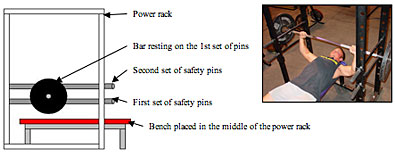
A functional isometric set-up for bench press: Start the bar at a specific height, and lift it two to three inches against a second set of safety pins. Then hold the position for six to nine seconds. Keep on adding weight until you can't lift it. Just hold the bar firmly against the second set of safety pins for at least six seconds, while maintaining a good lifting posture. Source: www.t-nation.com

The goal is to put the maximum resistance at the point where the joint has the least mechanical advantage or sticking point (Zatsiorsky and Kraemer, 2006), the underlying logic being that if we gain strength at the most difficult angle, we will experience an improvement along the whole range of movement. For example, there are two such points for the elbow flexors, at 170º and 50º, very similar to those for the triceps.

THE EFFECTS OF FUNCTIONAL ISOMETRICS ON TRAINED ATHLETES
Keogh et col. (1999) evaluated the effects of functional isometrics on trained subjects using the bench press (6RM that included a 2'' maximum isometric contraction at 160º), and compared it with other classic methods for 6RM, eccentric training and power exercises. The functional isometrics group of participants registered the highest values for the concentric phase when doing 1RM. This is in line with the work of Jackson el al. (1985), Giorgi et al. (1989) and O'Shea and O'Shea (1989), who suggested that this method could be useful for experienced and very strong subjects to improve on 1RM (RM = repetition maximum).
Jesús Beltrán "Brother". Photo: Javipec
On the other hand, in the study by Keogh et al. (1999), the effects of this method over power and endurance were significantly lower than those experienced by the groups that used eccentric, explosive and heavy load (dynamic) methods.

WHAT ABOUT THE LESS TRAINED ATHLETES?
For non-trained subjects the results are more varied. Gentil et col. (2006) found that 10 reps of 5-second maximal isometric leg extensions with a load that provoked muscle failure, induced a greater blood lactate accumulation and time under tension than the more traditional dynamic repetitions. This facts, according to some authors, is associated to an increase in muscle volume and maximum strength.

CONCLUSIONS AND RECOMMENDED EXERCISES
In my opinion, the key issue here is that, according to the mentioned studies, we should manage to apply, during each repetition, a maximum or near maximum load both in the concentric and the isometric phase. We usually can bear 10-15% more weight with an isometric contraction than with a concentric one; so, when we momentarily lock-off, we should add (don't ask me how right now) that 10-15% load. Later we will propose an exercise that can fullfill those requirements.

Complex training
The above mentioned combination (a.k.a. conjugated, combination, bulgarian, or contrast (Cometti, 2000) training, is based on the postactivation potentiation (PAP) effect that results from mixing light and heavy loads and different types of contraction during the same set or session (isometric and dynamic, for example). Given that the exercises must be executed at the maximum possible speed and that different intensities are used, there will be an increased dynamic power (Pmax) and rate of force development during the lighter load exercise. This would have in theory a positive effect on neural activation, power and therefore on maximum strength.


LOOKING AT THE EFFECTS
Research into complex training has been done from two perspectives: the acute, immediate benefits of performing a heavy strength exercise as a warm-up prior to a maximal power or speed performance (such as vertical jump test) and the long-term training adaptations that can be developed from a periodized complex training program.
Regarding acute effects in Some studies have evaluated how combination training affects performance of the upper limb in power exercises like throws; they suggest that it can be as, but no more, effective than other "traditional" methods for children, women and people with a low training level (Ebben, 2000).

Nonetheless, as was the case with the previous method, it can be more beneficial for men, and for those with a higher level of training (Ebben and Watts, 1998), possibly due to their higher percentage of fast twitch fibers (Hamada et al., 2000), and/or their superior maximum strength (Ebben, 2002).
French, Kraemer and Cook (2003) did a study with fourteen track and field athletes, and data indicate that performing a sequence of repeated maximal isometric knee extensions (3 repetitions of 3 seconds)  prior to (30 minutes) selected dynamic exercise (0.25 seconds) may have favorable effects on performance beyond standards achieved without prior heavy loading. Lastly, it is interesting to note that the PAP ergogenic stimulus has been found to last between two-to-thirty minutes (Chiu, Fry, Weiss, et al. 2003; Rixon, Lamont, Bemden, 2007)
Luis Muñoz. Photo: Javipec

THE STATIC-DYNAMIC METHOD
There's a class of combination trainings popular among climbers, the so called iso-dynamic by Verjoshansky (1986), or static-dynamic by Cometti (2000). Depending on the desired effects, they can also be called iso-miometric and iso-ballistic. Now, the most used variant among european climbers is the one described by Cometti, that in our case consists of mixing pull-ups and lock-offs like this:
An explosive pull-up is done up to certain angle, then a lock-off is maintained for certain amount of time, and finally the pulling movement is finished at high speed. The author suggests the use of 2-second lock-offs, and loads of about 60% of maximum concentric strength for the pull-ups. In this video there's an example (min 3:25 to 3:50).

STUDY OF THE EFFECTS
I couldn't find any studies that tested the effects of this exercise on pull-up maximum strength and power endurance, on power when doing more specific exercises like campus board, or general climbing performance.
In theory, given the similarity to the pulling-locking gesture so common in climbing, it coul be of some interest. But it remains to be seen what for and how to use it.

WHERE CAN THIS METHOD BE OF HELP?
Several facts must be taken into account before answering:
Obviously, the deceleration that occurs when we stop pulling and lock, clashes with the explosive pulling force that we were generating the moment before.
Lega on "Supertitte", Castillo de Bayuela (Toledo, Spain). Photo: Carles de Diego. Source: carlesdediego.blogspot.com
Secondly, if we have to resume the interrupted movement in an explosive fashion, we will be subject to an effect observed by Tihanyi et col. (1989) and Van Cutsem and Duchauteu (2005): the act of performing an isometric contraction reduces the amount of force that can be immediately be applied per unit of time (RFD = rate of force development) in a subsequent concentric contraction. The explosive force will be lower than if we hadn't previously done an isometric contraction.
Mery on "Valle de Rosas", 8a+, Cuenca (Spain). Photo: javipec
Thirdly, regarding the development of locking-off strength, and lacking any relevant literature in this matter, it stands to reason that if we want to improve our maximum or explosive locking strength it will be more effective to work it by itself instead of mixing it with pull-ups. The reason is that the control of the load gets more difficult, because both types of contraction require different absolute loads and exertion durations.

So, especially for developing maximum strength (using more than 1RM), power, and power-endurance, the dynamic methods seem more effective when it comes to pulling; conversely, the static methods will be more suitable for maximum and explosive locking strength and locking power-endurance.
Nevertheless, there is an area where this method can be of help, and that is to improve our ability for swiftly and effectively transitioning from a dynamic contraction (pulling) to a static one (locking-off) and vice versa. Ability that, as we already know, is constantly demanded in our sport.
Oscar Martinez on "La Soucoupe", 7C+, Chironico (Switzerland). Photo: Joseba Saiz. Fuente: Oscar facebook profile
Training Objectives for Improving the Locking-off Ability
Summing up, with the intention of setting priorities and choosing a training methodology for our planning, we could determine different training goals, or different effects to have in sight related to lock-off ability:
  • Maximum locking strength
  • Explosive locking strength
  • Fast and effective transition form pulling to locking-off and vice versa
  • Power-endurance specific to the pulling-locking gesture
We have already gone over the two last, and the first is easy to figure out but, what about maximum locking strength? Is it not an oxymoron to put 'explosive' and 'static' in the same sentence? What can this possibly mean?
This explosive isometric exercise consists of trying to push the bar against the stoppers, or pulling it, in an explosive way. Source: articleselitefts.com
Explosive and maximum isometrics: fast and slow lock-offs
As stated by Verkhoshansky and Siff (2000) it would be very reductionist and wrong to define isometric contraction symply as one where a static muscle action takes place for certain amount of time. If we look at a graph showing how the force applied against an unmovable resistance until fatigue varies with time, we will see what is called the force-time (f-t) curve. The important word here is 'curve' and has several phases:

1- Force-generation or development phase: The muscle builds up tension until the Peak Maximum Force (PMF) is reached. It's been shown that this maximum isometric force takes at least 0,8 to 1 second.

Another remarkable aspect of this phase is that there is a moment, when the f-t curve is steepest, that is, the ratio between the force produced and the time to reach it is at its best. Such is the value for the maximum explosive force, the peak of force that has been achieved in the shortest possible time. This is around 30% of the PMF (max RFD in the graph below). Stone, Stone and Sands (2003) call "starting strength" the one that is applied during the first 30ms, and that determines the speed of the movement when we talk about a dynamic contraction. Do any of these figures remind you of the previous chapter?
Sample f-t curve. "Starting strength" is the force produced at 30ms; "explosive strength" is max RFD, which is the moment of highest explosive strength, and takes place at about 30% of PMF. "maximum strenght" or peak force (PF) is the greatest force produced under a given set of conditions. (Stone, Stone and Sands, 2007)
2- Steady State phase: Holding the maximum force. Lasts for about 3-6 seconds.

3- Final or Force-decay phase: Reduction in force due to fatigue.

According to this, we find fast or explosive isometric contractions where the generation-force phase is short, and the force generated per unit of time (RFD or explosive force) is very high; the downside is that there is no time to reach our maximum strength (PMF). Reversely, in a slow or maximum isometric the explosive component is much lower, but we can reach our peak force. Using one or the other is not only a question of what method we use to solve a movement; many variables take part, like personal climbing style, wall angle, hold size, finger strength (if we can barely grab a hold, we don't have time to gather a lot of maximum pulling or locking strength), and even muscle composition and training habits.
RFD curve for fast or explosive isometrics versus slow or maximum isometrics
Nacho Sanchez on Memento, 8C, Silvretta (Switzerland). Photo: Rebeca Morillo. Source: Nacho's blog
And now, if you have a lot of general climbing experience (more than 3 years), and upper body strength training experience (more than 3 years), a high pulling force (15-20 unweighted pull-ups, more than five with 5kg added weight); if you don't have any injuries or other limiting factors in your elbows; if you are convinced that, after absorbing all this information, it can help you countering some of your weaknesses, then I'll show you some exercises.
But that, will be the topic of the next entry in the series.

LINKS RELATED
Lock-off Training in Sport Climbing (I). Does Static (lock-offs) Training have any Effect over Dynamic (pull-ups) Performance?
 Lock-off Training in Sport Climbing (II) Does our locking-off ability have any influence on our performance? Is it so important to train it?
Lock-off Training in Sport Climbing (III) Do you really lock-off?
 

REFERENCES
  • Cometti, G. (2000): Los métodos modernos de musculación. Paidotribo.
  • Chiu, L.Z., Fry, A.C., Weiss, L.W., Schilling, B.K., Brown, L.E., & Smith, S.L. (2003). Postactivation potentiation response in athletic and recreationally trained individuals. Journal of Strength and Conditioning Research. 17(4), 671-677.
  • Ebben, W. P., Watts, P. B., Jensen, R. L. and Blackard, D. O. (2000): EMG and kinetic analysis of complex training exercise variables. Journal of Strength and Conditioning Research 14(4), 451-456.
  • Ebben, W. P. (2002): Complex training: A brief review. Journal of Sports Science and Medicine 1, 42-46
  • Fleck SJ, Kraemer WJ (1997). Fleck SJ, Kraemer WJ (2004): Designing Resistance Training Programs, ed 2. Designing Resistance Training Programs. Human Kinetics Publishers 
  • French, DN, Kraemer, J, Cooke CB (2003) Changes in Dynamic Exercise Performance Following a Sequence of Preconditioning Isometric Muscle Actions. Journal in Strength and Conditioning Research, 17(4), 678-685
  • Gentil, P., Oliveira, E., and Bottaro, M (2006): Time under Tension and Blood Lactate Response during Four Different Resistance Training Methods. Journal of Physiological Anthropology; 25(5): 339–344
  • Giorgi A., Wilson GJ, Weatherby RP (1998) Functional isometric training: its effects on the development of muscular function and the endocrine system over an 8- week training period. Journal of Strength and Conditioning Research, 12, 18-25
  • González Badillo JJ and Gorostiaga Ayestarán E. (1995) Fundamentos del entrenamiento de la fuerza. Aplicación al alto rendimiento deportivo. Zaragoza: INDE; 1995.
  • Gonzalez Badillo and Ribas, J (1996): Fundamentos del entrenamiento de la fuerza. Inde
  • González-Badillo, JJ, and Izquierdo, M. (2008): Evaluación de la fuerza en el control del entrenamiento y el rendimiento deportivo. In Izquierdo, M. (editor); Biomecánica y Bases Neuromusculares de la Actividad Física y el Deporte. Panamericana
  • Hamada, T., Sale, D.G., MacDougall, J.D., and Tarnopolsky, M.A. (2000): Postactivation potentiation, fiber type, and twitch contraction time in human knee extensor muscles. J Appl Physiol, 88: 2131–2137 
  • Jackson, A.; Jackson, T., Hnatek, J., and West, J. (1985): Strength development: Using functional isometrics in an isotonic strength training program. Res. Q. Exerc. Sport, 56:234–237.
  • Keogh, J.W.L., Wilson, G.J., and Weatherby, R.P. (1999): A Cross-Sectional Comparison of Different Resistance Training Techniques in the Bench Press. Journal of Strength and Conditioning Research, 13(3), 247–258
  • O’Shea, K.L., and O’Shea, J.P. (1989):  Functional isometric weight training: Its effects on dynamic and static strength.J. Appl. Sport Sci. Res.3(2):30–33
  • Rixon, K.P., Lamont, H.S., and Bemden, M.G. (2007). Influence of type of muscle contraction, gender, and lifting experience on postactivation potentiation performance. Journal of Strength and Conditioning Research, 21(2), 500-505.
  • Tihanyi J, Bosco C, Fekete G, and Apor G (1989) The effect of muscle structure and training conditions on the rate of torque development. Review of the Hungarian University of Physical Education, Budapest, 185-198
  • Zatsiorsky VM, and Kraemer WJ (2004) Science and Practice of Strength Training-2nd edition. Human Kinetics
  • Van Cutsem, M., and Duchateau, J. (2005). Preceding muscle activity influences motor unit discharge and rate of torque development during ballistic contractions in humans. The Journal of Physiology, 562(2), 635-644.
  • Verkhoshansky, Y., and Siff, M. C. (2004). Superentrenamiento.Madrid. Paidotribo.