Showing posts with label Training apps for climbing. Show all posts

Tuesday, May 25, 2021

Happy Fingers app. An interactive e-book to learn about Finger training for climbing


 DESCRIPTION

In the middle of the rush for applying AI (Artificial Intelligence) and Machine Learning to training apps, #Happy Fingers wants you, rather than the machine, to be the one that actually learns something. It wants to make you smarter.

Happy Fingers has the following goals:
• Answering all of your questions related to finger training for climbing;
• Carefully guiding you in the process of choosing some training method or grip type;
• Describing how to warm up; how to hang or how to perform each program;
• Teaching you how to control the training load to ensure the desired effects;
• Offering alternatives to keep from stalling;
• Preventing injuries, overtraining and excessive fatigue in your forearms;
• Describing different training methods and the optimal exercise for each circumstance;
• Providing a range of training programs for each method, level and athletic goal to choose from.

I’m Eva López; climbing is my passion and the topic of my doctoral thesis on Finger Endurance and Strength Training in Climbing. I developed Happy Fingers with the aim of making you the main character in your growth process, looking at the reasons behind any hitch you find while training, offering strategies to keep your motivation or progressing in the long run. Of course, your personal situation, objectives and needs will always be part of the equation.

All of the above is based on the most up to date research and what I’ve learned along my 20+ years of observation, analysis and experimentation. I have adapted all that knowledge to the individual characteristics of every person I’ve trained, including myself, to refine and complete the process. Linking Science & Experience, relating Theory & Practice, Evidence-based Training, all describe this educational resource that will help you get the most out of your workouts and your climbs.

I want to make clear that the Happy Fingers app does not automatically churn out training programs from some initial evaluation. It's best characterized as an interactive ebook full of information and advice, but it will never command you to follow some path without challenging it. Individualization is a staple of training, the Holy Grail. You decide. You’re on the driver’s seat.

CONTENTS:

1. BEFORE YOU HANG.
11. Are dead hangs for me?
1.2. Terminology.
1.3. What gear do I need

2. THE BASIC DILEMMAS

2.1. Strength or Muscular Endurance?
2.2. Which Method do I Choose?
2.3. Which Grip Type to Use?

3. TRAINING METHODS
3.1. Maximal Head Hangs.
3.2. Submaximal Dead Hangs.
3.3. Intermittent Dead Hangs.

4. THE FINGER MEETS THE EDGE
4.1.Dead Hangs Technique.
4.2.Warming Up.
4.3. Control of the Load. Self-regulation.

5. PERIODIZATION
5.1. The Dead Hangs Session.
5.2. The Training Week.
5.3. Proposed Training Plans.
5.4. Improving in the Long-Term.
5.5. Monitoring and Directing your Training.

6. THE ROAD TO PERSEVERANCE
6.1. Staying Motivated.
6.2. Reducing the Risk of Injury.

Future updates will bring even more contents, mainly in Methods, Programs and Physiological Adaptations.

Strong Fingers are Happy Fingers
Fingers with an Evidence-Based Approach are Happy Fingers
Well-coached fingers are Happy Fingers 

 Download on the App Store here. 

Get it on Google Play here.


FAQ about Happy fingers.

1. THIS APP IS DESCRIBED AS AN INTERACTIVE E-BOOK, but, Why not to release a tangible book, what makes it different?

  • Knowledge is always in your pocket. Any question that could arise during training may be solved right away.
  • You can enjoy new updates without paying an additional price for them. In the case of a book, you neeed to purchase the new edition.
  • You can navigate among all the sections. Each section and screen includes several links to different parts where possible new questions can be answered. The structure and system of navigation is based on how we learn.

2. THE PRICE, IS MONTHLY, yearly, or do you pay just once for it?

  • This app doesn't have a subscription model. You pay for it and it'll be yours forever. Including future updates with new contents.


3. ¿ARE YOUR BOARDS, PROGRESSION OR TRANSGRESSION, NECESSARY, for training with the methods proposed by #Happyfingers?

  • No, they aren't necessary. Happy Fingers provides you information about how to train, offering much more knowledge than just methods and training programs, but in any case, you'll always choose which method and program to use according to several things. One of them is your goals, but another one is the board you've already own. In this sense, Happy Fingers also includes a section about what characteristics should your board have and makes some recommendations.
  • Obviously, if you would like to train with the Minimal edge method, and your board only includes hold sizes too big or too small for you, it will be hard to make it work. But you can always figure out some solution, or opt for other methods. Besides, happy fingers also suggests you how to make your own board or what other exercises you might use apart from dead-hangs.


4. IS THERE AN IOS VERSION YET?

Friday, July 28, 2017

Intermittent Dead Hangs Programs for Your Smartphone


Spanish version

It's been a while since I last updated this blog, and I've finally decided to do it for two reasons:

The first and foremost is the need to clarify some aspects that seem to generate a bit of confusion; these include the dead-hangs methods I put forward, together with a set of periodization schemes whose aim is to develop finger strength and endurance in climbers, both mid- and long-term.


The second motive is that I want the results of my latest research to be known to the public because, specially out of Spain, my name is associated mainly to finger maximum strength methods, those where we use the [near] maximum possible added weight (MAW) or the smallest (minimal) edge (MED).

With time, as my thesis can attest, I looked at the effects of intermittent dead hangs (usually known as repeaters) not only as a strength-endurance method, but also to gain strength via hypertrophy. This topic is present in my PH.D. thesis, in the training videos from my Youtube channel, the abstract that I presented at the most recent climbing congress and in the training guide that accompanies the Progression and Transgression hangboards. Why all of the above has gone under the radar is a bit of a head scratcher, but perhaps it is related to the first paper I published in 2012 that compared two maximum strength methods, or my first research and writing being about that same quality. No matter the reasons, it is understandable.

From now on, you will be able to have the Progression and Transgression Training Guides' Programs in your smartphone. Note: Excuse me for not providing a higher resolution pictures of the posters. I am not allowed to, since they are only available for those who purchase the hangboards. However, if you are interested in knowing these hangboard training programs (and more), don't worry because they will be available for everyone very soon.


The next entries will try to fill the gap, discussing this method and its effects, and how to combine it with your maximum strength methods both during a cycle and in your long-term planning. I'll begin with an extended version of the paper I presented in the summer of 2016 during the III International Rock Climbing Research Congress that took place in Telluride (Colorado, USA).

In the meantime, here you have several intermittent dead-hangs programs that you can load in Complex Timer, the Android app that I talked about in an earlier blog post. You can download the app here, and then choose to install the beginner (A) program or the advanced (B) one or both, attending to these criteria:

a) your previous experience with intermittent dead-hangs
b) your current level of finger strength and endurance


By the way, these programs that you will have handy in your phone or tablet are part of the Training Guides bundled with each Progression or Transgression finger board, and a bit more current at that. And there are more coming.

Tutorial: how to install the Intermittent Dead Hangs Training Programs


Complex Timer runs in your mobile device, so it makes sense for you to download the training programs with it.


1- If you don't have Complex Timer yet, download it from the play store.

2- Tap this link to access my training programs cloud folder.

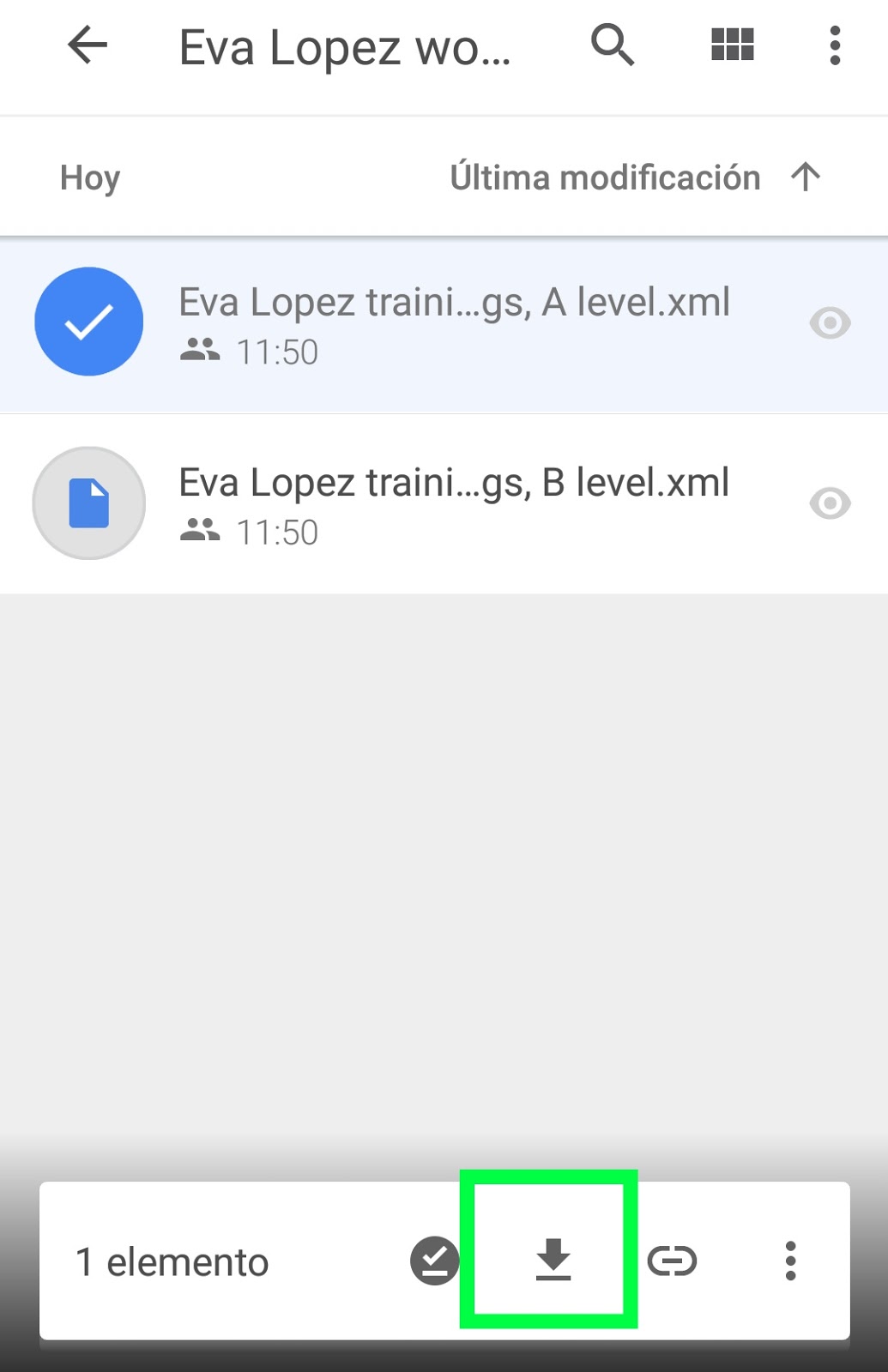
3- Long tap the file you want and select the download icon from the pop-up menu:

4- Open Complex Timer and make a backup of your existing sessions or workouts first. Tap "Backup sessions" from the three-dots menu and they will be saved to /ComplexTimer/backups.

The app will ask for permission to access your phone's storage if you haven't already granted it, so do it now.

5- Back in the three-dots menu tap "Restore backup"


Browse to the location where you downloaded the training programs. In the example I downloaded them to Complex Timer’s “backups” folder, but very likely they will be in your Downloads folder.


6- A dialog will pop up asking if you want to delete the Sessions you already have; you'll probably want to choose "NO" here.

7- Now you have several 8-week programs (8 weeks is what is needed for this method to show effects. as we will see in the next entry), divided into 4 sub-levels (two for each level A and B) that are intended to perform in order. In this sense, I highly recommend you don't advance fast, but instead, you repeat several times each until you no longer see improvement.

If you already were training intermittent dead hangs now it'll be even easier; if not, you must first learn what this methodology is about and then start with level A1.

In the days to come we will extensively delve into this topic but, for the impatient among you, here are the most important bits of knowledge:

a) choose an edge size (depth) that allows you to honor the buffer or effort level set for each repetition, that has to be hard but no so much that you reach failure before the end of the session;

b) it is ideal to end the last repetition of the last set with failure or near failure. If you feel that you are getting exhausted too early switch to a bigger edge for the next repetition. If you have the opposite feeling, go for a smaller one, no matter if the set has not ended yet.

How do I find the right edge depth?
This varies from one individual to another, and from one time to the next. If you really want to progress you have to evaluate the conditions for each repetition, day and circumstances (meteorology, fatigue, skin, level, etc). But do not lose sight of the objective, that is completing all the proposed volume.

And now, let's work out!!!!
 
Download my training programs from the cloud store here

Wednesday, December 28, 2016

Complex Timer: A Training app for Climbing


Versión en español

As you know, for some Endurance training methods like Extensive Interval Training or Intermittent Dead-hangs/ Repeaters, several nested countdowns are needed.

After years of trying lots of interval timer apps and finding that none of them suited all of our particular training needs, my boyfriend, Daf, decided to write his own.

Basic Tutorial

As its name reveals, it can be a bit unusual at first glance, so a tutorial was in order.
Hope you like it.

Features

- Backup and restore your sessions.
- Copy a session to use it as a template for a new one.
- Group countdowns that repeat several times.
- Nest a group inside another one to create complex patterns.
- Move countdowns or whole groups up/down or even inside/outside groups.
- Copy countdowns or groups to save time.
- Goup and countdown descriptions are customizable.
- Set the type of alarm that will be played before a countdown starts, so that you know if a pause or a work segment comes next.
- Set an alarm to warn you before the time is up.
- Choose among 9 different colors for each countdown.
- Skip any particular repetition(s).
- Choose whether the session will pause when a countdown ends.
- Skip backward/forward while running a session.
- Keep the screen on while running a session.
- See the complete session in list form to have a visual reference of what it's going to look like, and use it to skip to any particular countdown.
- Run, pause and reset the session from the lockscreen notification.
- Receive an alarm that indicates the whole session has ended.
https://play.google.com/store/apps/details?id=com.deslomator.complextimer&hl=en

If you feel curious, give Complex Timer a try and let me know what you think of it (or leave a comment in Google Play)

Thank you and happy training!