Versión en español
The previous entry was a first look at the Intermittent dead-hangs training method. There I explained why I chose that name over Repeaters and presented the INTRODUCTION to the first of my studies that compared this method to others, focusing on their effect on finger strength and endurance. This particular work was presented at the III International Rock Congress set up by the IRCRA that took place in Telluride (USA) in 2016. Today, as promised, we will have a more detailed discussion about each aspect of the study:
Goals, Methods, Results, Discussion and Practical Applications
(CONDENSED INFOGRAPHIC at the bottom).
You have the full text of the article in this link; so, instead of reproducing it here verbatim I will explain and elaborate every part except for the introduction, that we have already covered in the previous post. As you might know, the length of a text to be presented in a congress has a limit, just 2 pages in this case.
 |
| Beginning the presentation of my study:“Comparison of the Effects of Three Hangboard Training Programs on Maximal Finger Strength in Rock Climbers” at Telluride (Colorado, USA), III IRCRA congress |
 |
| Photo: Real Life Photographs |
OBJECTIVES
Comparing the effects on maximal grip strength of an 8-week Maximal Dead-hangs training program (MAXHANGS_MAXHANGS) with an Intermittent Dead-hangs one (INTHANGS_INTHANGS) and a third that combined Maximal and Intermittent Dead-hangs (MAXHANGS_INTHANGS).

METHODS
Apparatus
The device chosen to perform the training and the tests was the one described in López-Rivera and González-Badillo (2012), and consisted on and edge that could be adjusted in depth with a precision of millimeters (Dimensions 500x250x24 mm; by Eva López and Dafnis Fernández, 2004; Creative Commons Attribution-NonCommercial-ShareAlike 3.0 Unported License).
Participants
After being informed in writing about the objectives, characteristics and risks of the study, 26 rock climbers (23 male, 3 female) with and average redpoint level in the past 6 months of 7c+/8a (min 7a, max 9a), 31.7 years of age and 11.7 years of climbing experience were selected under the following criteria:
a) more than 2 years of climbing experience.
b) being active in the sport during the previous 6 months.
c) not having trained dead-hangs for the past 4 months.
d) having a redpoint level of at least 7a.
e) being more than 25 years old.
f) not suffering from an injury or condition that made inadvisable to follow an intensive physical training.
The participants signed their consent and were asked not to change their daily habits or engage in any additional physical activity other than the one prescribed for the duration of the intervention.
Procedures
Strength Test (ST)
This was the one proposed by the aforementioned authors, which had already validated it by observing the significant positive correlation between the test results and redpoint level (r = 0.51; p < 0.001). The ST took place before starting the intervention, in week 5 after the first four weeks of training and in week 9, after the eighth week of training (see figure below). Data collection was carried out at the Club Vertical climbing facility (Toledo, Spain).
The training session 48 hours before the test was light, and 24 hours prior to the test no sport activity was allowed. Each participant knew the conditions and rules of the test and had learned the right dead-hangs technique. The successive tests were conducted the same day of the week, at the same time and in similar conditions of temperature and air moisture. The warm-up before the test was a 15-minute standardized routine that included neck, shoulders arms, wrists, fingers, upper body, hip and legs mobilization; a specific part of 3-5 dead-hangs followed, decreasing edge depth (20-15 mm according to sport level) and increasing hanging time (10-20 seconds), with pauses 2-3 minutes long. A 5-minute rest was observed before the test itself, during which weight and height were measured. Then the ST was conducted.
A 15 mm edge was chosen for ST, using the half-crimp grip, with extended elbows and the maximum added weight that could be held for 5 seconds. The load was determined as follows: the first try an added weight was chosen that would allow the participant to hang for 15-20 seconds. Then, with 5-minute intervals, 5 to 10 kg were added taking into account the previous try’s perceived intensity. The goal was to reach the maximum load in five tries at most, to prevent the effects of fatigue. When the participant could not keep contact of all fingers with the edge, flexed their arms or modified the angle of the shoulders or the hip with the torso before the 5-second mark, the test was finished and load for the last valid try was recorded.
Among all possible grip types, the half-crimp was chosen because it is the most used on small holds (Bollen, 1988; Schweizer, 2001, Quaine & Vigouroux, 2004, Watts, 2004), small hold size being characteristic of the hardest sections in difficult routes (Quaine & Vigouroux, 2004, Watts, 2004), along with shape and texture. Lastly, dead-hangs were selected due to several authors considering it a climbing-specific exercise (Vigouroux et col., 2006; Watts et col., 2008), and it being a popular one among climbers.
 |
| Michaela Kiersch training at the First Ascent Avondale climbing gym (Chicago, USA). Picture: Musenpet. Source: Facebook |
Experimental Design
Based on the results of the first ST the participants were randomly assigned to one of three training groups using the ABCCBA method:
1- MaxHangs_MaxHangs: this group did in the first four weeks of training 3 to 5 sets of 10-second dead-hangs on an 18-mm edge with added weight (named as MAW = maximal added weight at the infographic at the bottom). The weight should allow the athlete to hang for 13 seconds, which implies a 3-second margin (effort level = 3; term proposed by González-Badillo & Gorostiaga in 1993). The pause between sets was 3 minutes. During the next 4 weeks, the progression in number of sets, hanging time, effort margin and pause were the same; the difference was that no added weight was used: the load was adjusted by choosing the smallest (less deep) edge (named as MED = Minimal edge, at the infographic at the bottom) that would allow to hang for 13 seconds.
Warming-up was specific to these methods, doing 3-4 sets with increasing added weight or decreasing edge depth (50-90% of previous session’s load). There was a need to determine the load for the first set of the first day of training: the climber would estimate an added weight or edge depth that would permit a 13-second repetition. If this repetition was perceived as too difficult or too easy for the session, some weight (2-5 kg depending on body weight) or edge depth (1-2 mm) was added or subtracted to keep the load constant. This procedure was iterated in each set. For context, the strongest athlete used 55 kg / 5 mm, the less strong 5kg / 10 mm.
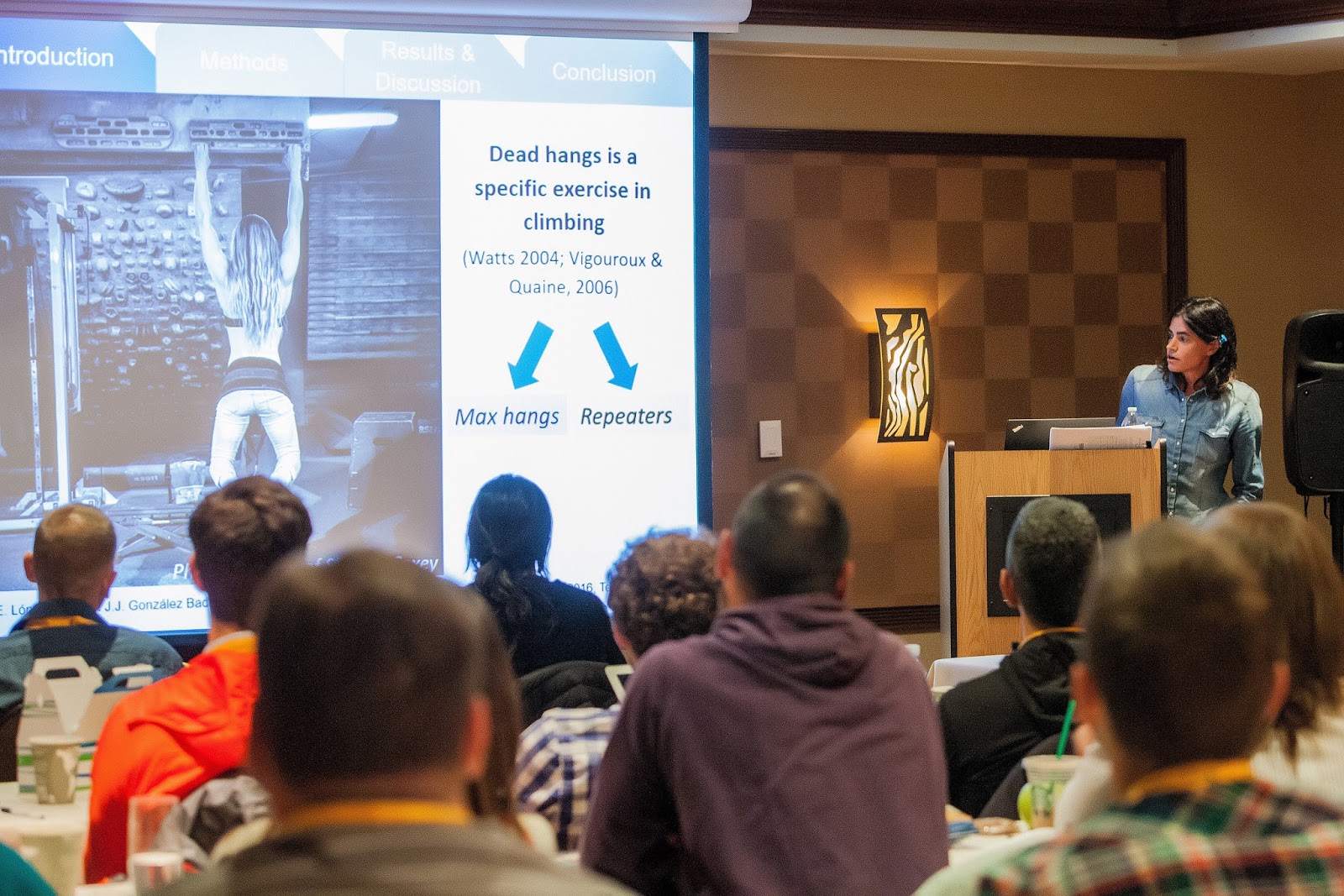 |
| Presenting at Telluride. Thanks to Kaycee Joubert, from Real Life Photographs for taking this picture and to Shauna Coxsey por giving permission to use hers! |
2- IntHangs_IntHangs: the Intermittent method in the first 4 weeks consisted of 3-5 sets of 4 repetitions, each repetition being a 10-second dead-hang; the pause was 5 seconds between repetitions and 1 minute between sets. No added weight was used, the load was managed by choosing the smallest edge (MED) that would allow to complete all the prescribed volume and reach failure or close to failure in the last repetition of the last set. The second 4-week segment the number of repetitions per set went from 4 to 5.
For this method a different warming-up procedure was followed: 4-5 10-second sets, with a 5-second pause and decreasing edge size; the edge for the first set should have allowed the climber to hang for one minute, which amounted to 5-10 mm deeper than the training edge from the last session. For the first set of the first training session the initial training edge was deep enough to hang for up to 30 seconds.
Load training management was analogue to the MaxHang method: if the participant estimated that the current edge was going to be too easy or too hard to complete the volume close to failure, he or she would change to a smaller or bigger one. For reference, the smallest edge used with this method was 8 mm, the deepest, 22 mm.
3- MaxHangs_IntHangs: This group combined both methods. The first 4 weeks they trained with added weight like group 1 (MAW); the following 4 weeks, 3 to 5 sets of 4 repetitions of 10-second dead-hangs with the same parameters as group 2. The intensity was adjusted as has already been described.
 Across all methods the hanging time was 10 seconds, the number of sets 3 to 5. Every athlete had to manage the training load dynamically throughout the session by choosing a different added weight or edge depth to keep the relative intensity constant.

This said, there was a difference in total volume among methods, because MaxHangs amounted to 30 to 50 seconds per workout while total hanging time in IntHangs was 120 to 250 seconds.
Furthermore, the Max methods avoided failure by prescribing a 3-second margin, while IntHangs actively aimed for failure at the end.
Furthermore, the Max methods avoided failure by prescribing a 3-second margin, while IntHangs actively aimed for failure at the end.
The rationale behind the 10-second hanging duration, and for the 10 to 5 work/pause ratio respectively can be found in the previous blog post.
Training Program
Dead-hang programs
The set/reps configuration, hanging time and pause duration for each group can be found in this figure:

Physical-technical training
It is worth noting that the athletes did not reduce their workout to dead-hangs only; these were instead integrated into a weekly plan as it would be the case in real life. Therefore, there were conditioning and climbing contents carried out in the climbing gym. The whole of the training schedule was an 8-week standardized cycle (ATR-model, block periodization approach; edited on 20 March 2018), adapted to each person, that included all contents. This plan was built and supervised by Eva López.
Dead-hang workouts were done on Mondays and Wednesdays, after the mentioned standard warm-up. A 15-minute recovery would follow and then the other contents for the day according to the mesocycle: physical conditioning like maximal and sub-maximal pull-ups, core; as well as extensive or intensive interval, repetition or projecting methods on boulders and routes, no name but a few.
Gym work happened Monday to Thursday, the weekend was devoted to rock climbing. The participants were instructed to do 1-2 routes for warming-up and 1-2 close to their maximum level. All of this was checked via daily feedback shared by the climbers.
 |
| Eva López. Club Vertical climbing facility (Toledo). Photo: Javipec |
STATISTICAL ANALYSIS
Descriptive statistics (averages, standard deviations) were obtained for age, years of training, height, weight, sport level in the last 6 months and ST results. A repeated measures ANOVA with Bonferroni correction was applied to assess the intra- and inter-group differences in strength. Pearson’s correlation was computed to look at the relations between variables as well as the effect size (ES) to check for intra-group changes (Hedges & Olkin, 1985). An ES < 0.25 was defined as moderate and > 1 as big in line with the scale proposed by Rhea (2004) for strength training interventions with highly trained athletes.
RESULTS
The differences among groups in ST were not significant, either before and after 4 and 8 weeks of training. However, it is worth noting the 28% of improvement in ST after 8 weeks experienced by the MaxHang_MaxHang group, as well as that the strength gains only reached statistical significance in this group and not in the others; and the better outcome after 4 weeks of the groups that did MaxHangs with added weight (15% and 20%) in contrast with the IntHangs group (4.6%).

The second interesting result was the relatively small change in strength by IntHangs_IntHangs after 4 weeks (4.6%) that tripled at the end of the 8th week (13.9%), a result comparable with what MaxHangs achieved in the first 4 weeks.

Finally, the group that changed from MaxHangs to IntHangs in the 5th week lost almost 7% of the gains developed during the MaxHangs mesocycle.
 |
| Results by group in the strength test (maximal added weight hold for 5 seconds off a 15 mm edge, half-crimp grip) after 4 and 8 weeks of training. Source: www.researchgate.net/profile/Eva_Lopez-Rivera |
DISCUSSION
To the extent of our knowledge this is the first work to compare the effects on grip strength of a MaxHangs program, an IntHangs program and a combination of both in experienced sport climbers (7c+/8a average level, 12 years of experience). The most effective program after 4 and 8 weeks of training was MaxHangs_MaxHangs, which was also the only one to show significant change in ST3 (p < 0.05).
CHANGES AFTER 4 WEEKS
The early gains yielded by MaxHangs after 4 weeks with added weight can be attributed to neural changes (Hakkinen & Komi, 1985a; Hakkinen et col., 1998; Sale et col., 1998) and are comparable to the 15-18% observed after 4 to 6 weeks of a similar isometric training (3 to 10-second sets, >80% MVC, complete recovery) by Ikai & Fukunaga (1970), Cannon & Cafarelli (1987) and Davies et col. (1988) with untrained subjects. Also in this line Judge et col. (2003) reported maximal isometric force going up by 15% in throwers after gradually increasing volume and intensity during a 16-week period, in this case through dynamic exercises.
We are not aware of other studies that assessed the effects of a static training with loads on trained athletes, as is the case of this one. On the other hand there are several examples of dynamic exercises producing strength improvements in athletes by the use of loads. Hickson et col. (1988) found a 30% significant change in 1 RM in cyclists that underwent a 10-week cycle doing 3x5 RM strength exercises. The fact that this figure is higher than the one registered by us could be explained by the longer duration of the intervention, or by the participants lacking experience with lower body strength training while having a well-developed specific endurance; the authors do not mention whether this is the case or not.
The only work we have found where a 4 week dead-hangs program is carried out, by Medernach et al. (2015), included a group of boulderers who significantly improved their time to fatigue with the maximum added weight corresponding to an initial hanging test for 6 seconds off a 19 mm edge, by contrast with the group that only did bouldering, with significant but more modest gains (12.5± 2.5 seconds, 8.6 ± 2.0 seconds respectively). However, these results can’t be compared with ours, having a different test and intervention design, mainly because instead of setting different dead-hangs methods side to side it compared a control group with another that did 1 session of MaxHangs and 2 of IntHangs each week; additionally, the dead-hangs programs included pull-ups and lock-offs.
Effects of intermittent dead-hangs after 4 weeks
The IntHangs group improved their strength just 4.6% at ST2. One reason can be not using added weight, or that the intensity was lower than in the other groups; these factors have been shown to be related with maximal strength going up in experienced athletes like the ones in this study (Hakkinen, 1994; Tan, 1999; Fry, 2004; Peterson, Rhea & Alvar, 2005). The lower intensity results from the incomplete character of the recovery pauses (5 seconds between repetitions, 1 minute between sets) as well as from the higher resulting TUT (time under tension) (Rhea et col., 2003; Watts et col., 2004; Mirzaei et col. 2008), that make it unfeasible to maintain a high absolute load during the session. Our estimate is that the relative intensity was 70-80%, corresponding to 30 seconds of maximal hanging time, compared to the 90% which could be associated to the 13 seconds of MaxHangs.
CHANGES AFTER 8 WEEKS
The MaxHang group confirmed the trend after the first training phase and ended up ahead of the others in ST3, after 8 weeks of training (28% up, compared to 13.9% IntHangs_IntHangs and 13.4% MaxHangs_IntHangs). Added weight probably played a role in this respect, causing greater muscle activation and recruitment of motor units (Hakkinen et col., 1985a and 1985b; Sale, 1988; Harris, 2000), which in turn made possible to use smaller edges during the last four weeks resulting in sustained strength gains.
This 28% change in 8 weeks is lower than the 35% improvement in MVC obtained by Jones & Rutherford (1987) with isometric training, doing 4 x 6 repetitions at 80% of MVC, 4 seconds per repetition and 2 seconds between repetitions for 12 weeks. Rich & Cafarelli (2002) registered also a notable 35% change in MVC in 8 weeks doing 5 x10 maximal contractions, 3 to 5 seconds in duration each. These figures could be attributed to the workouts being prescribed to persons lacking strength training experience, where greater development is to be expected.
As far as we know there are no studies looking at experienced athletes doing static training for more than 4 weeks. However, gains similar to the ones shown in this study, 20 to 30%, have been reported in dynamic tests with participants familiar with strength training (Hakkinen et col., 1985b), trained cyclists (Rønnestad et col., 2010) or competitive swimmers (Tanaka et col., 1993) who performed dynamic training, 1 to 10 RM for 10 weeks.
The better outcome in strength of the group that worked their strength first with added weight and then without it (MaxHang_MaxHang) compared to the other two groups is consistent with the findings of our previous study (López-Rivera & González-Badillo, 2012), where this sequence of exercises also showed a greater effect on strength than the opposite, starting with the minimal edge depth exercise and following with added weight. It is worth noting that this earlier work yielded a 1.34% improvement in strength (for 28% of the current one), a difference which may result from the disparity in level between samples (8a average, 7a min., 9a max. 11.1 years of practice versus 8a+/b average, 8a min., 8c+ max and 16 years of experience in the earlier work). As suggested by authors like Hakkinen et col. (1987) or Peterson, Rhea & Alvar (2004), the expected change after a given training gets smaller as sport level and experience go up. Stronger athletes familiar with strength training show a smaller adaptive response and need a higher dose of strength training (Hakkinen et col., 1987).
THE EFFECTS OF THE INTERMITTENT HANGS METHOD
The second noteworthy result concerns group 2, which used a method generally deemed to promote strength-endurance. Strength going up 4.6% in ST2 did not come as a surprise, but then they achieved a 13.9% change from ST1 to ST3).
The literature offers a possible cause for this good outcome after 8 weeks; doing 4-5 repetitions per set, 10 seconds each repetition amounts to a long TUT; in addition the intensity is sub-maximal and the pause incomplete (5 seconds between repetitions and 1 minute between sets). These characteristics have been hypothesized as promoters of strength by hypertrophy, mainly by adding sarcomeres in parallel rather in series (Kraemer et col., 1990; Hakkinen, 1994; Behm, 1995; Robinson et col., 1995; Fleck & Kraemer, 1997; Hoffman et col., 2003; Goto et col., 2005; Toito & Boutellier, 2006; Ratamess et col., 2007, Willardson, 2007; Miranda et col., 2009) caused by high lactate-induced metabolic stress, hormonal stress, muscle damage and, most importantly, by mechanical tension associated to moderate to high-load training (Hakinnen et col., 1994; Goto et col., 2005; Schoenfeld, 2012), effect becoming more evident after 6-8 weeks of training unlike in the case of the neural adaptations characteristic of the first weeks of training (Hakkinen & Komi, 1985a; Hakkinen et col., 1998; Sale et col., 1998).
The 13.9 difference in strength after 8 weeks of doing 3 - 5 x 4 - 5 x10” :5”/1’ are below the 33% change in MVC after 8 weeks of electrostimulation of the first dorsal interossei of the hand in the form of 4 sets of ten 10-second repetitions with 20 seconds of pause between repetitions and 2 minutes between sets, by Davies et col. (1988). Jones & Rutherford (1987) also recorded a 35% increase in MVC when doing 4 x 6 isometric contractions at 80% MVC, each repetition 4 seconds long, 2-second pauses between repetitions for 12 weeks. Another result that yielded higher figures than ours is Schott et col. (1983), after a 5-week intervention where the participants performed 10 sets of 3-second isometric contractions, with pauses of 2”/1’, and ended up gaining 31%. Lastly, McDonagh et col. (1983) observed a 20% MVC improvement when doing 30 to 50, 3 – 5 seconds long isometric contractions of the elbow flexors, with a recovery duration of 20 seconds, for 5 weeks. All these works used a variety of protocols that differ with ours, but they have in common the participation of persons who lacked experience in strength training, and this may explain part of the differences in outcome. There is one study where an isometric training program was prescribed to trained athletes: Gondin et col. (2005) looked at the effects of 32 18-minute sessions of 40 isometric contractions via electrostimulation of the knee extensors, the change amounting to 6% and 27% after 4 and 8 weeks respectively. While the first 4 weeks the numbers of this study and ours are comparable, the gap widens at the end of the 8th week, probably due to the mentioned work involving a longer TUT than the IntHangs exercise (25 10-second contractions at most); this variable has been advanced as a factor affecting in the magnitude of hypertrophy by some authors (Sale et col., 1985 [in Wemborg et col., 2007]) and its associated strength gains.
EFFECTS OF THE COMBINATION OF 4 WEEKS OF MAXIMAL DEAD-HANGS AND 4 WEEKS OF INTERMITTENT DEAD-HANGS
We want to underline a last interesting result, the 6% loss in strength by the MaxHangs_IntHangs group (group 3) from the 5th to the 8th week after the positive change observed in the first 4 weeks with added weight. Changing the stimulus to a lighter one could be behind this downturn. Similarly, Rhea et col. (2003) observed an effect size (ES) of negative 0.31 in 1 RM after increasing the number of repetitions every five weeks from 15RM to 20RM and 25RM, and thus diminishing the intensity, compared to a control group where the intensity went up, from 25RM to 20RM and 15RM
On the other hand, a training method that involves incomplete recovery on small edges is more suitable for improving strength-endurance and is liable to provoke a level of fatigue after 4 weeks that the climbers can’t recover from when the time for ST3 comes, not to mention the implications that can have on the effects of the IntHangs, the fact that this group obtained great strength improvements in ST2. Presumably, being able to train with this tiring method using smaller edges could provoke greater fatigue due to a greater muscle activation (Ahtiainen & Häkkinen, 2009) (Also, the smaller the hold is, the more mechanical tension is needed to grip it
effectively, and the more intense -physical and psychological- the resulting effort is). As Anderson & Kearney (1982) suggest, training-induced fatigue can have different effects depending on the way it is produced. In their work, the participants who did a higher volume (100-150 RM) experienced greater homeostatic perturbations in the muscle.
Lastly we have to keep in mind that individual characteristics like muscle fiber composition (Thorstensson & Karlsson, 1976; Willardson, 2006) or genetic profile (Ginszt et al., 2018) that can lead to a greater fatigability among other consequences, can have a non-trivial effect on training response (as hinted by the large standard deviation recorded in this group) when the sample size is as small as ours and therefore a big impact on final results.
Taking all this into account we would suggest carrying out a follow-up study that extended the program by doing 8 additional weeks of IntHangs.
CONCLUSION AND PRACTICAL APPLICATIONS
Summing up, the group that displayed greater strength gains was the one that did 8 weeks of MaxHangs. The IntHangs_IntHangs group experienced little change in the first four weeks but strength went up noticeable after the last four, probably because there was time for hypertrophy to set in. Last, it seems that 4 weeks of MaxHangs and 4 weeks of IntHangs would not be advisable in terms of strength outcome, presumably due to 4 weeks being too short a duration for the second method.
The overall results are indicative that MaxHangs are more suited to develop grip strength in climbing, specially in the short and medium term. Nevertheless, with the sights set on the long-term outcome of trained athletes, we are in a position to suggest that sequentially prescribing MaxHangs and IntHangs methods could be a way to avoid plateauing and get greater changes in strength because the neural development caused by the high loads of MaxHangs would add up to the hypertrophy effects of IntHangs.
 |
| Who said people of science are boring? Photo: Real Life Photographs |
 |
| See you at Chamonix 2018? Picture: Real Life Photographs |
AND HERE ENDS THE PRESENTATION OF THIS RESEARCH ARTICLE…
… but don’t leave before this appeal to caution. Please, remember that a single work must not be taken as definitive proof, and that an intervention evaluated through a scientific study can’t be generalized to every kind and level of climbing or repeated in your planning time and again. Training prescription should be always specific to individual goals and abilities (this last sentence was added on 21 March 2018). Furthermore, reading just an abstract and extrapolate it, as well as jumping directly to the conclusions here or the infographic below keeps you from learning the details, 😝 where more often than not resides the nuance that we need to relativize and actually learn). No matter how effective a method is shown to be for a group of people at certain moment in time (be it by your own experience or a controlled, standardized experiment), when dealing with trained athletes the evidence says that periodization (changing parameters, like volume and intensity, according to a previously defined schedule, like the weekly variation in number of sets in this work) and method sequentiation are superior to the alternative, performing the same routine indefinitely (Kraemer et al., 2000; Rhea & Alderman, 2004; Grgic et al., 2017). A quick example would be changing the hanging (exertion) time, or the effort margin in the MaxHangs, as well as the recovery pauses or the hanging time of IntHangs every four weeks…
I’m afraid we have to leave this here, but I encourage you to accompany me in this exploration, and in the next entry we will look at some, more specific training plans that can be effective.
THE CONDENSED INFOGRAPHIC
 |
| MAW = Maximal Added Weight; MED = Minimal edge. Clic to enlarge |
RELATED LINKS
-Why do intermittent dead hangs?
-Dead Hang Training (6 of 6): The Intermittent Dead Hangs Method (Video)
-Presentation of the article "Comparison of the effects of Three Hangboard Training programs on Maximal Finger strength in rock climbers" at the 3rd IRCRA congress (PDF version)
-Comparison of the Effects of Three Hangboard Training Programs on Maximal Finger Strength in Rock Climbers (conference paper)
-Intermittent Dead Hangs Programs for Your Smartphone
-Complex Timer: A Training app for Climbing
- The effects of two maximum grip strength training methods using the same effort duration and differ
- Abstract of the article "Comparison of the Effects of Three Hangboard Strength and Endurance Training Programs on Grip Endurance in Sport Climbers"
REFERENCES
- Ahtiainen, J.P. y Häkkinen, K. (2009) Strength athletes are capable to produce greater muscle activation and neural fatigue during high-intensity resistance exercise than nonathletes. Journal of Strength & Conditional Research 23(4): 1129-1134.
- Anderson, T., and Kearney, J.T. (1982). Effects of three resistance training programs on muscular strength and absolute and relative endurance. Research Quarterly for Exercise and Sport, 53(1), 1-7.
- Bollen, S.R. (1988). Soft tissue injury in extreme rock climbers. British journal of sports medicine, 22(4), 145-147.
- Campos, G. E., Luecke, T. J., Wendeln, H. K., Toma, K., Hagerman, F. C., Murray, T. F. and Staron, R.S. (2002). Muscular adaptations in response to three different resistance-training regimens: specificity of repetition maximum training zones. European journal of applied physiology, 88(1-2), 50-60.
- Cannon, R.J., and Cafarelli, E. (1987). Neuromuscular adaptations to training. Journal of Applied Physiology, 63(6), 2396-2402.
- Davies, J., Parker, D. F., Rutherford, O. M. Y Jones, D. A. (1988). Changes in strength and cross sectional area of the elbow flexors as a result of isometric strength training. European journal of applied physiology and occupational physiology, 57(6), 667-670.
- Gondin, J., Guette, M., Ballay, Y., and Martin, A. (2005). Electromyostimulation training effects on neural drive and muscle architecture. Medicine and science in sports and exercise, 37(8), 1291.
- Badillo, J.J.., & Gorostiaga, . (1993). Fundamentos del entrenamiento de la fuer za. Aplicación al alto rendimiento deportivo.
- Fry, A.C. (2004). The role of resistance exercise intensity on muscle fibre adaptations. Sports medicine, 34(10), 663-679.
- Ginszt, M., Michalak-Wojnowska, M., Gawda, P., Wojcierowska-Litwin, M., Korszeń-Pilecka, I., Kusztelak, M., Korszeń-Pilecka, I., Kusztelak, M., Muda, R., Filip, A., Majcher, P. (2018) ACTN3 genotype in professional sport climbers. J Strength Cond Res, doi: 10.1519/JSC.0000000000002457.
- Goto, K., Nagasawa, M., Yanagisawa, O., Kizuka, T., Ishii, N. y Takamatsu, K. (2004). Muscular adaptations to combinations of high-and low-intensity resistance exercises. The Journal of Strength & Conditioning Research, 18(4), 730-737.
- Grgic, J, Mikulic, P, Podnar, H, and Pedisic, Z. (2017). Effects of linear and daily undulating periodized resistance training programs on measures of muscle hypertrophy: a systematic review and meta-analysis. PeerJ 5: e3695
- Hakkinen, K., Komi, P.V. and Alen, M. (1985a). Effect of explosive type strength training on isometric force and relaxation time, electromyographic and muscle fiber characteristics of leg extensor muscles. Acta Physiologica Scandinavica 124(4):587-600.
- Hakkinen, K., Komi, P.V. and Alen, M. (1985b). Effect of explosive type strength training on electromyographic and force production characteristics of leg extensor muscles during concentric and various stretch-shortening cycle exercises. Scandinavian Journal in Sports Science; 7: 65-76.
- Hakkinen, K., Komi, P.V., Alan, M. and Kauhanen, H. (1987). EMG, muscle fibre and force production characteristics during a 1 year training period in elite weight-lifters. European Journal of Applied Physiology. 56:419-427.
- Häkkinen, K. (1994). Neuromuscular fatigue in males and females during strenuous heavy resistance loading. Electromyography and clinical neurophysiology, 34(4), 205-214.
- Häkkinen, K., Kallinen, M., Izquierdo, M., Jokelainen, K., Lassila, H., Mälkiä, E., ... and Alen, M. (1998). Changes in agonist-antagonist EMG, muscle CSA, and force during strength training in middle-aged and older people. Journal of Applied Physiology, 84(4), 1341-1349.
- Harris, G.R., Stone, M.H., O’Bryant H., Prolux C.M. and Johnson R. (2000). Short term performance effects of high speed, high force and combined weight training methods. The Journal of Strength & Conditioning Research 14: 14-20
- Hickson, R.C., Dvorak, B.A., Gorostiaga, E.M., Kurowski, T.T. and Foster, C. (1988). Potential for strength and endurance training to amplify endurance performance. Journal of Applied Physiology 65(5):2285-90.
- Ikai, M. y Fukunaga, T. (1970). A study on training effect on strength per unit cross-sectional area of muscle by means of ultrasonic measurement. European Journal of Applied Physiology and Occupational Physiology, 28(3), 173-180.
- Jones, D.A. and Rutherford, O.M. (1987). Human muscle strength training: The effects of three different regimens and the nature of the resultant changes. Journal of Physiology, 391:1-11.
- Judge, L.W., Moreau, C. y Burke, J.R. (2003). Neural adaptations with sport-specific resistance training in highly skilled athletes. Journal of Sports Sciences 21(5):419-27.
- Kraemer, W. J., Marchitelli, L., Gordon, S.E., Harman, E., Dziados, J.E., Mello, R., ... and Fleck, S.J. (1990). Hormonal and growth factor responses to heavy resistance exercise protocols. Journal of Applied Physiology, 69(4), 1442-1450.
- Kraemer, W.J. , Ratamess, N., Fry, A.C., Triplett-McBride, T., Koziris, L.P., Bauer, J.A., Lynch, J.M., and Fleck, S.J.(2000). Influence of resistance training volume and periodization on physiological and perfor- mance adaptations in collegiate women tennis players. Am J Sports Med 28: 626–633.
- López-Rivera, E. and González-Badillo, J.J. (2012). The effects of two maximum grip strength training methods using the same effort duration and different edge depth on grip endurance in elite climbers. Sport Technol 5: 1–11.
- López-Rivera, E., and González-Badillo, J.J. (2016). Comparison of the Effects of Three Hangboard Training Programs on Maximal Finger Strength in Rock Climbers. In Northern Michigan University (Ed.), 3rd International Rock Climbing Research Congress, Telluride, USA 5th-7th August 2016. Telluride (Colorado, USA): IRCRA.
- McDonagh, M.J.N.; Hayward, C.M. y Davies, C.T.M. (1983). Isometric training in human elbow flexor muscles. The Journal of Bone and Joint Surgery. 65, 3:355-358.
- Medernach, J.P.J., Klein Der, H., and Tzerich, H.H.H.L.(2015). Fingerboard in competitive bouldering: training effects on grip strength and endurance. J Strength Cond Res 29: 2286–2295.
- Mirzaei, B., Nia, F. R. and Saberi, Y. (2008). Comparison of 3 different rest intervals on sustainability of squat repetitions with heavy vs. light loads. Brazilian journal of biomotricity, 2(4), 220-229.
- Morán‑navarro, R., Pérez, C.E., Mora‑rodríguez, R., De La Cruz‑sánchez, E., González‑Badillo, J.J., Sánchez‑medina, L., Pallarés, J.G. (2017). Time course of recovery following resistance training leading or not to failure. Eur J Appl Physiol. doi: 10.1007/s00421-017-3725-7.
- Peterson, M.D., Rhea, M.R. and Alvar, B.A. (2004). Maximizing strength development in athletes: a meta-analysis to determine the dose-response relationship. The Journal of Strength & Conditioning Research, 18(2), 377-382.
- Quaine F. and Vigouroux L. (2004). Maximal resultant four fingertip force and fatigue of the extrinsic muscles of the hand in different sport climbing finger grips. International Journal Sports Medicine 25: 634-637.
- Rhea, M.E., Alvar, B.A., Burkett, L.N. and Ball, S.D. (2003). A meta-analysis to determine the dose response for strength development. Medicine & Science in Sports & Exercise 35(3)456-464.
- Rhea, M.R. and Alderman, B.L.(2004).A meta-analysis of periodized versus nonperiodized strength and power training programs. Res Q Exerc Sport 75: 413–422.
- Rich, C. and Cafarelli, E. (2000). Submaximal motor unit firing rates after 8 weeks of isometric resistance training. Medicine and Science in Sports and Exercise, 32, 190-196.
- Rønnestad, B. R., Hansen, E.A., and Raastad, T. (2010). Effect of heavy strength training on thigh muscle cross-sectional area, performance determinants, and performance in well-trained cyclists. European Journal of Applied Physiology, 108(5), 965-975.
- Sale, D.G. (1988). Neural adaptations to resistance training. Medicine & Science in Sports & Exercise 20: S135 - S245.
- Schoenfeld, B.J. (2012). Does exercise-induced muscle damage play a role in skeletal muscle hypertrophy?. The Journal of Strength & Conditioning Research, 26(5), 1441-1453.
- Schott, J., McCully, K., Rutherford, O. M. (1995). The role of metabolites in strength training. European Journal of Applied Physiology and Occupational Physiology, 71(4):337-341.
- Schweizer, A. (2001). Biomechanical properties of the crimp grip position in rock climbers. Journal of Biomechanical 34:217-223.
- Tan, B. (1999). Manipulating resistance training program variables to optimize maximum strength in men: a review. Journal of Strength and Conditioning Research, 13, 289-304.
- Tanaka, H., Costill, D. L., Thomas, R., Fink, W. J. and Widrick, J. J. (1993). Dry-land resistance training for competitive swimming. Medicine & Science in Sports & Exercise 25(8): 952-959.
- Thorstensson, A. and Karlsson, J. (1976). Fatigability and fiber composition of human skeletal muscle. Acta Physiol. Scand. 98: 318–322.
- Toigo, M. and Boutellier, U. (2006). New fundamental resistance exercise determinants of molecular and cellular muscle adaptations. Eur J Appl Physiol 97: 643–663.
- Vigouroux, L. and Quaine, F. (2006). Fingertip force and electromyography of finger flexor muscles during a prolonged intermittent exercise in elite climbers and sedentary individuals. Journal of Sports Sciences, 24(2), 181-186
- Watts, P.B. (2004). Physiology of difficult rock climbing. European Journal of Applied Physiology 91: 361-372.
- Watts, P. B., Jensen, R.L., Agena, S.M., Majchrzak, J.A., Schellinger, R.A., and Wubbels, C. S. (2008). Changes in EMG and finger force with repeated hangs from the hands in rock climbers. International Journal of Exercise Science, 1(2), 62-70.
- Wernbom, M., Augustsson, J. and Thomé, R. (2007). The influence of frequency, intensity, volume and mode of strength training on whole muscle cross-sectional area in humans. Sports Medicine; 37 (3): 225-264.
- Willardson, J.M. (2006). A brief review: factors affecting the length of the rest interval between resistance exercise sets. J Strength Cond Res 20: 978–984.




 https://orcid.org/0000-0003-0304-5290


 Posts


